


If you were to ask someone to name the definitive Christmas film, chances are pretty good that It’s a Wonderful Life would be the first title to roll off their tongue. It’s a film that has not only endured but gained in popularity since its release 78 years ago. As a kid, It’s a Wonderful Life was an annual viewing in my home on Christmas Eve. As eager as my sisters and I were to go to bed in anticipation of Santa Claus, we knew that we would first be watching George Bailey get flogged by life over and over again until diving off a bridge into the freezing, watery depths below suddenly seemed like a reasonable solution to all of life’s problems. Perhaps it was too dark a theme for young kids to truly grasp and appreciate, but it certainly stayed with me through the years. Eventually, George’s plight began to hit differently. As adults, we watch this film with different eyes. We each have our own struggles and sacrifices, and we’ve also certainly had a moment or two where we’ve wondered… what would the world have been like had we never been born. Do we really make a difference? Would everyone have been better off without us? The beauty of It’s a Wonderful Life is that while we feel George’s pain, we also feel his joy. We see what, for the majority of the film, he cannot – that his existence touches so many around him – that he matters. It’s a profound message to put out into the world and one that I believe is needed now more than ever.

What It’s a Wonderful Life Means to Us
I only have vague memories of It’s a Wonderful Life from childhood. It wasn’t really a staple in my family (we’d more likely be busting a gut during A Christmas Story or watching Rudolph the Red Nosed Reindeer for the umpteenth time), and I never had the urge to revisit it as a younger man. That all changed when I got married and it turned out to be my wife’s favorite Christmas movie. Something we watched every year (along with A Nightmare Before Christmas, which was more my speed). If I’m honest, I mostly watched it to humor her, not out of any desire of my own. Somehow, though, that’s changed over the years. As you get older the question of whether or not the life you’ve lived is worth it becomes more relevant. The anquish of setbacks and losses and uncertainty grows stronger and more poignant. That horrible question – would the world be better off without me in it? – pops up more than you would like.
And It’s a Wonderful Life makes me take stock. Make lists of things I’ve done and things I need to do. Of people I love and people who love me. To count the wins, as my wife says, and not just the losses. In some ways It’s a Wonderful Life is a fractured take on A Christmas Carol, but instead of three ghosts it’s just the one dopey angel, and instead of focusing on Scrooge it focuses on Bob Cratchit, and instead of being about making up for what you haven’t done it’s about celebrating what you have done. Okay, so maybe not so much like A Christmas Carol, but for me it’s become just as much an iconic Christmas tale. One that reminds me not to take anything for granted – not even myself. Happy Holidays, Screenagers.
–Bob Cram
I think it’s safe to state that every single person has at one point wondered what life would look like if they never existed. How would their family and/or friends’ lives be different? I came to It’s a Wonderful Life a bit late in life. I had already seen countless TV shows take a crack at the material with holiday episodes inspired by the classic Christmas movie. I’d already heard the iconic quote, “Every time a bell rings an angel gets his wings,” across my life. I’d be familiar with the beats of the movie even if I had never watched it. However, as Romona has already touched on, the original hits differently than any TV episode-inspired attempt. Simply put, it’s a lot easier to relate to George Bailey, who believes he has possibly wasted his life away. I mean, who hasn’t thought that?
However, as someone who enjoys a good “What if?” storyline, it’s seeing how George has impacted those around him that I believe is the true message. You might not think it’s a big deal to take a few minutes out of your day to hold the door open for those behind you, smile at a passerby on the street, or pay for someone else’s meal, but for those individuals, it could very well make all the difference in their lives. It’s a Wonderful Life serves as a nice reminder that our dreams may look different than how we initially envisioned them and that every life is of value.
–Marmaduke Karlston
A Post-World War II Performance
In 1939, Philip Van Doren Stern wrote a short story titled ‘The Greatest Gift’, which he later included with his Christmas cards to friends and family. The story focuses on a man named George Pratt, who experiences what the world would be like had he never been born. The story was later published in 1945 and caught the eye of RKO star Cary Grant. RKO bought the film rights as a starring vehicle for Grant. However, the rights were later sold to Frank Capra’s Liberty Films, who tapped James Stewart in the lead role of George, whose last name was also changed to Bailey.
After serving four years of military service during World War II, Stewart returned to Hollywood, having witnessed the horrors of war. Those closest to him claim he seemed to have aged ten years and suffered from attributes of PTSD. Despite this, It’s a Wonderful Life was the first commercial film he signed on to do, and it’s easy to see how his real-life experiences influenced his performance as George. According to Turner Classic Movies, the scene where a distraught and defeated George prays to the man above for guidance was done in one take. While George recited the Lord’s Prayer in the original script, the studio felt it was too problematic, so Stewart improvised his own.
“I’m not a praying man, but if you’re up there and you can hear me, show me the way. I’m at the end of my rope.”
In an era of constant Hollywood remakes, it isn’t easy to imagine anyone taking on the task of remaking such a beloved film. Not only due to the magic and nostalgia that It’s a Wonderful Life evokes but also because of the authenticity of Stewart’s performance. There is so much of Stewart’s experiences in George Bailey that I fear the impact of the performance would be impossible to replicate today.


The Kiss
There are so many moments in It’s a Wonderful Life that I could talk about, but as I do not think anyone is here to read a novel’s worth of gushing, I will focus on one moment that affects me during every single rewatch. No, it’s not George’s friends and family coming together to help him out of his financial jam while toasting him as the richest man in town – though that never fails to make me misty-eyed. It’s George and Mary’s first kiss.
George Bailey has just met his younger brother’s new wife, and while he is happy for Harry, he also understands that his brother now has a wife to support, and a good job offer from his father-in-law. George’s dreams of leaving Bedford Falls to travel and attend college are once again put on hold.
His mother, however, makes it a point to tell him that Mary Hatch is back from college. Mary, who has had a crush on George since childhood, has clung to one magical night shared with George four years prior, where their flirtations culminated in George promising to lasso the moon for Mary. When Ma Bailey pushes a sullen George in the direction of the Hatch residence, it’s unclear just how this reunion will go. Mary is thrilled to see George. She’s had a caricature drawn of George lassoing the moon, and she gleefully plays a record of Buffalo Gals, a song sung by the two as they walked home together that night so many years ago. While George is dismissive of Mary, it’s clear there is an attraction there, something George is trying desperately to ignore. He knows what falling in love will mean, and his future plans are so much bigger than marriage and children. George and Mary argue, and George leaves just as their mutual friend, and Mary’s romantic pursuer, Sam Wainwright calls.
Mary has no interest in Sam, but is determined to make George jealous anyway. When Sam hears George is around, he gets them both on the phone to try and convince them to invest in plastics. But George and Mary, who are both sharing the phone, are distracted by their close proximity to one another. Their chemistry is palpable. Sam tells Mary to inform their friend that this is a chance of a lifetime. When she repeats this to George, it’s clear that she isn’t talking about plastics. The sexual tension of the scene boils over into an angry George denying that he wants anything to do with plastics or marriage until he and Mary are embroiled in a passionate embrace. The kiss was so steamy that part of it had to be cut to pass the censors.
As with George’s prayer, the kiss was done in one take. Stewart had been putting off filming it as long as he could – having been away for so long, he felt a bit rusty filming love scenes – but perhaps some of that frustration and nervousness seeped its way into the scene itself. It’s undoubtedly one of Hollywood’s greatest on-screen kisses. And to top it off with a bit of humor, Mary and George’s embrace sent away a scandalized Mrs. Hatch in the process.
The Villain
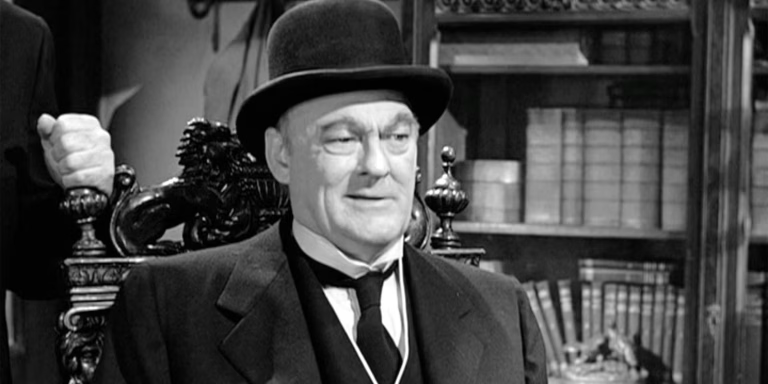
Of course, we had to take a moment and discuss Mr. Potter. Wildly considered one of cinema’s greatest villains, Mr. Potter is a man we all know far too well. Unlike many villains, he is not a physical threat. He is wheelchair-bound due to polio (and actor Lionel Barrymore’s own arthritis and hip injuries). He gets pushed around by a wordless assistant that reminds me so much of Lurch from The Addams Family. However, that doesn’t affect how deeply intimidating Potter is. He is wealthy, greedy, and controlling, eager to push around the little guy and exert his power. His one true adversary is George Bailey, a man who understands Potter’s motivations and has the backbone to stand up to him. He’s truly the hero to Potter’s villain. Indeed, the only way Potter can potentially gain the upper hand over George is to fabricate a financial scandal. Barrymore was the perfect casting for a man like Potter. He was known in the 1940s for playing Ebenezer Scrooge in various radio dramatizations, and it’s easy to see some character parallels between Scrooge and Potter. But while Scrooge finds redemption at the end of his journey, Potter does not. Or, rather, we don’t know for sure if he does or not. It’s never really explicitly dealt with. One of the only areas of contention in this movie, many people find the lack of comeuppance for Potter to be the movie’s one main flaw.
The last we see of Potter, he’s called the police to arrest George for embezzlement. All the while, we know Potter came across those funds by mistake, having been unknowingly given to him by Uncle Billy, too busy boasting about the Bailey brothers to realize what he’s done. While I can understand the point of view that the money should have been found and that Potter should have faced some kind of reckoning, I feel as though the ending of It’s a Wonderful Life was Potter’s punishment. The entire town came out to help George—everyone from his childhood friends to his brother to the inspectors who had arrived to arrest him. George’s life is filled with love and admiration. He has a beautiful family and people who would do anything for him, just as he has done for them. What does Potter have? Money and a grumpy-looking crony to do his bidding. No one in town would come to his aid like they did for George. George’s happiness is Potter’s comeuppance.
The Legacy
It’s a Wonderful Life wasn’t always the holiday staple it is today. While it failed to find an audience in the post-World War II era, many critics still praised the film, singling out Frank Capra’s direction and James Stewart’s performance. In fact, both would receive Oscar nominations that year. It was a small achievement considering the film’s box office failures. It wasn’t until 1974, when the film’s copyright owner failed to file for renewal that It’s a Wonderful Life found its audience. Since the film had entered the public domain, television stations could play it whenever they wanted without spending a dime, and they did. The film invoked a sense of nostalgia many were searching for, and its themes of resilience and finding self-worth struck a chord with the public. Decades later (now owned exclusively by NBC), It’s a Wonderful Life continues to be an annual viewing tradition in most households. A reminder that no man is a failure who has friends.
Do you have a favorite scene or quote from It’s a Wonderful Life? Share it in the comments below!