


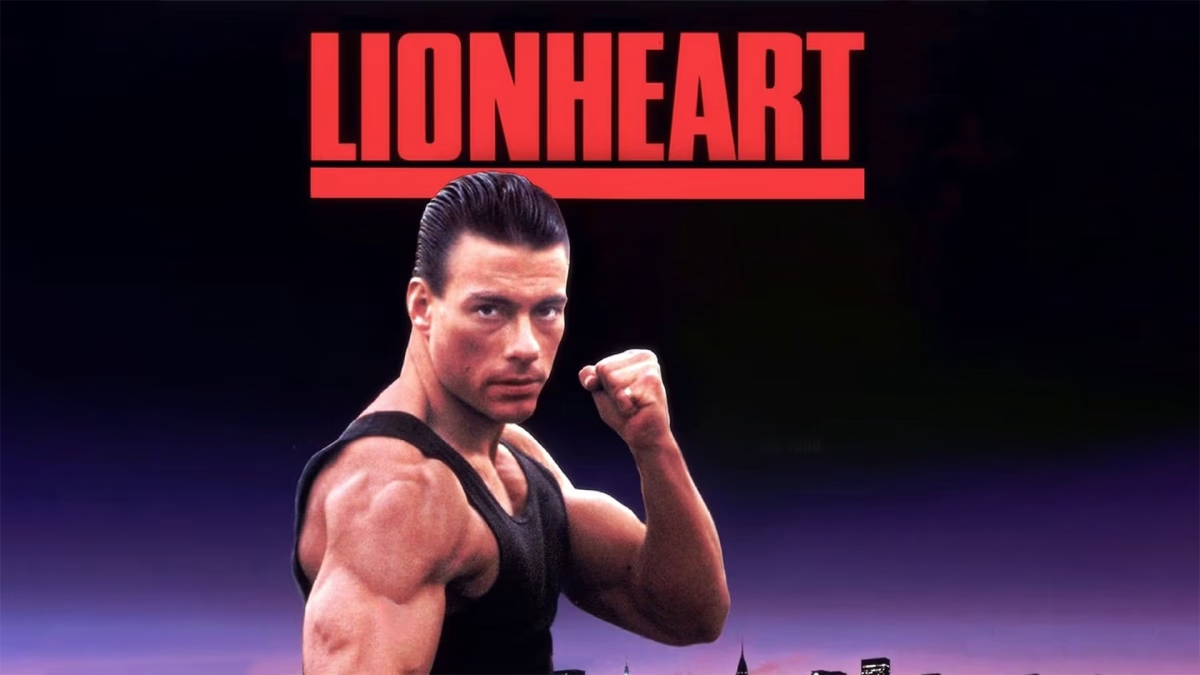
Over on my new channel, Kung Pew Video, I’ve been revisiting the direct-to-video relics that raised us. This week: Lionheart.

The Subgenre that Keeps on Giving
You know what subgenre never gets old? The Underground Fight Ring movie. I never get tired of watching these movies. In fact I just watched another one last night with Lorenzo Lamas. That one was weird, so count on a review of it soon. But whether it’s the campy Gymkata, the classic Bloodsport, or the grandaddy of them all, Enter the Dragon, I’m always down for one more.
So today, we’re gonna talk about one of my favorites of the sub genre. And whether you’ve never seen it and want to know why you should…or you’ve seen it a million times, already love it, and just want to hear someone else gush about it, come along with me as we dive into the early 90s Van Damme classic–Lionheart.
The Back of the VHS
Chances are, if you’re thinking about checking out Lionheart, plot isn’t your biggest concern, but we always gotta do the back of the VHS thing here at Kung Pew Video just so we have a baseline to start from.
So what is Lionheart about?
The movie opens in LA with a drug deal gone wrong. We watch as a guy looking to score gets set on fire by a gang of thugs. Why? We never find out. But it turns out this dude is the brother of Van Damme’s character, who we later find out is called Lyon – hence the name.
Van Damme’s bro is in real bad shape, and apparently he’s not too swell of a guy and has left his wife Helene and daughter Nicole with a mountain of hospital bills and expired health insurance. Helene is played by Lisa Pelikan who starred in Ghoulies five years prior and Ashley Johnson plays the daughter Nicole. Lionheart was Johnson’s first role, and she went on to be cast as Chrissy Seaver in the hit TV show Growing Pains later that same year.
Helene writes to Lyon, pleading with him to come to his brother’s aid. But as it turns out, Lyon is a soldier in the French Foreign Legion stationed somewhere in the middle of the desert in Africa, and his commanding officer is a real dick and not too sympathetic to his family crisis. Instead, they decide to lock him in solitary confinement, so Van Damme says No thanks, I’m good, kicks all their asses, and flees into the desert in a stolen Jeep.
He jumps a steamer headed to the land of plenty, but the ship’s captain does him dirty, and Van Damme has to abandon ship in the Big Apple where he arrives cold, hungry, and with only the clothes on his back.
Fortunately, as he walks the back alleys of New York city, he overhears a commotion coming from beneath a highway overpass, where he meets a man named Joshua (played by Harrison Page) who introduces him to wealthy socialite and fight fixer Cynthia Caldera (played by Deborah Rennard) and the world of high stakes underground fighting.
The rest of the movie plays out a bit like a video game, with Van Damme literally fighting his way up a chain of tougher and tougher fighters as he tries to help his family out of their tough spot. All the while he is being pursued by two guys from the French Foreign Legion who are determined to bring him back and see him face a court martial.
Vibe Check
Now that all sounds pretty dire, but Lionheart is fun. And it’s drenched in that 80s–90s borderlands energy. Stone washed jeans, tank tops, gold teeth, shoulder pads in ladies power suits…yeah, man, Lionheart is very of its time.
But it’s also sincere, and the story, though stretching the imagination considerably, is earnest. The characters are solidly-written, even if they’re all basically archetypes. They at least feel human, with human problems, and human weaknesses. It’s cheesy and melodramatic at times, but it wears its heart on its sleeve, and at a time when subversion trumps sincerity in movies, Lionheart feels like a breath of fresh air.
Why So Re-watchable?


Lionheart is a B martial arts flick about underground fighting rings produced by Imperial Entertainment–the same company that produced Cybertracker, Bikini Car Wash II, and Showdown.
But it’s surprisingly a very well-made movie.
Acting, direction, cinematography, set design, music, casting, the scope of the world–all of it seems a cut above what is typical for an Imperial picture. And what’s even more surprising is that Lionheart was Sheldon Lettich’s first time in the director’s seat. For what it is, the movie feels like something directed by, at the very least, a genre veteran. But at this point, Lettich was only known for writing Bloodsport and co-writing Rambo III.
Now most of us don’t come to movies like Lionheart for acting, direction, deep themes, or the cinematography.
We come for the fights.
And we’ll get to that, but before we do, I think it’s worth mentioning a few of the performances.
The Performances
Lionheart is Van Damme’s movie, but Harrison Page’s Joshua is the emotional heartbeat at the center of it, and this guy steals every scene he’s in. His dialogue comes off so natural, and even though he seems like he’s trying to scam Van Damme for the first part of the film, you feel yourself being taken in by his charm. He just grounds all of the late 80s silliness in something real, something human. Harrison Page’s film career never seems to have really taken off, but he’s got a ton of credits in TV–including The Dukes of Hazzard, 21 Jump Street, and the underrated police satire Sledge Hammer!
I know for me personally, Lionheart wouldn’t have the re-watchability that it does with someone other than Page as Joshua. He is just fantastic in this.
Deborah Rennard as the cunning and sophisticated Cynthia is also perfectly cast here. Cynthia quickly realizes Lyon is her champion horse, and she moves to get her hooks into him permanently. She tries money, clothes, and even seduction. But nothing works on the pure-of-heart Lyon, and when she realizes he’s got baggage threatening to drag him down, she moves to use it against him and level herself up in the process. Rennard plays the cold and calculating Cynthia flawlessly, creating a character that is easy to root against.
I never thought I’d be talking about Van Damme’s acting talent in a review, but he’s actually really good in this and shows some actual range. His character is kind of stoic and doesn’t say much, which is not unusual for these kinds of characters, but that’s not all he is. Lyon is actually pretty naive, and Van Damme manages to convey this in pretty subtle ways. He even cries in this, and as silly as it sounds, it’s actually an emotional scene. But that’s not the only emotional scene he has in this. Near the end of the film, there’s a pretty great scene between him and Joshua that I won’t ruin. But if that scene doesn’t get you to feel something, man I don’t know what to tell you. Check your pulse. Nobody won any Oscars for this, but these guys are doing real work here, and I’m here for it.
Alright, alright, enough about thespians.
The Fights
What about the fights?
The fights in Lionheart are top notch. Every set piece feels like the final boss of a video game level. Each one is distinct, well-choreographed, and well-shot. Van Damme throws lots of signature hook kicks and in this movie he uses this knuckle strike that I can’t recall showing up in his other movies. Pretty sure it’s never used in Bloodsport. But it’s cool.
All of the fights are fun, even the ones that take place outside of the ring. But my favorite remains the poolside fight, because Van Damme is fighting another kicker, and I think the scene is more dynamic because of it.
Probably the strangest fight of them all, though, is the one that happens in the warehouse between Lyon and the Scotsman. For some bizarre reason, there are people flitting here and there on rollerskates as expensive cars roll in and take their places before the fight. This was a very particular decision, and I can’t think of any reason why this scene needed rollerskating except that someone was probably doing a bunch of cocaine when they conceived this scene. Whatever the reason, I’m glad it made it on film, because it’s just such a quintessentially 80s thing to do, and it’s just one more reason to love this movie.
A Who’s Who of Martial Arts
Interestingly enough, there are loads of martial arts movie veterans in this that could have probably been better utilized, but their contributions are fun and worth pointing out. And if you are a fan of this genre, this will be of interest.
- One of the legionnaires chasing Lyon is the childhood friend of Van Damme, Michel Qissi, who played Tong Po in the Kickboxer series.
- His older brother Abdel plays Attila, the final boss. This was Abdel’s first role and it was originally supposed to go to Michel, but Michel asked the producer Ash R Shah to give the role to his brother. Michel was then cast in the part of the legionnaire.
- Speaking of Tong Po, Kamel Krifa, who plays one of Atila’s bodyguards, was later cast as Tong Po in the oddball sequel Kickboxer 4, yet another movie about underground fighting rings.
- Richard Norton plays the guy fighting Attila in the video Lyon is shown before agreeing to fight one last time.
- Billy Blanks has a small role as one of the legionnaires Van Damme has to fight to break out of the camp in Africa. If you aren’t paying attention, you wouldn’t even realize it’s him. But he’s there. I wish he’d had a bigger role, but c’est la vie.
- Imperial executive and director Eric Karson plays the doctor who treats Lyon’s brother. Eric Karson served as a producer on Albert Pyun’s Nemesis and directed Angel Town with Olivier Gruner and The Octagon with Chuck Norris. He does a good job portraying the solemn doctor here.
- Vojislav Govedarica plays the other legionnaire in pursuit of Van Damme’s Lyon to America. This guy was also in Red Dawn, Rambo 2, and another Van Damme flick, the odd duck Nowhere to Run. This guy comes off as hard as one hard son of a you-know-what. I would have pegged this guy for sure as ex-military, but I can’t find any info anywhere to suggest a military background. So maybe he’s just a damn good actor.
- Jeff Speakman has a tiny role in the movie as mansion security for the Attila fight. I never saw him, though, so he must be in the background. Apparently he read for Van Damme during casting, but was trying to launch a real acting career and not get type cast in martial arts movies. That didn’t work out so well.
- Jeff Langton plays the first guy Lyon fights in NYC. Jeff played the uncredited final bad guy that Ken McCleod fights in College Kickboxers. Jeff is sorely underutilized in his fight scene with Van Damme, probably because they wanted to downplay this character’s skills. Still, if it were me, I would have moved Jeff to the second fighter, because this guy has range as a fighter. Watch the final scene in College Kickboxers and you’ll see what I’m talking about. The dude can move.
- But Jeff Langton isn’t the only College Kickboxers alum. One of that movie’s stars, Mark D. Williams, has a small part as one of the fighters fighting under the overpass when Van Damme first meets Joshua. And once again, he’s kinda wasted here, but it makes sense why. After Van Damme wins his fight, Joshua remarks about his foreign fighting style. If Williams had been throwing the pretty kicks he throws in College Kickboxers, it would have undermined that line and stolen our hero’s thunder. Still, it’s cool to see him here.
- Paco Christian Prieto shows up in the pool fight in L.A. Prieto played Silverio, the Brazilian drug dealer and Mark Dacascos’s capoeira nemesis in Only the Strong. He looks intimidating and his martial arts skills look great on camera.
- Frank Dux, the man Bloodsport is based on, performed stunts for Lionheart. Much of what supposedly happened in that film has been called into question and Dux is thought of in many martial arts circles as a fraud. Viking Samurai has loads of videos about this on his channel that are worth checking out, if you are interested in this little bit of martial arts movie controversy.
- Now this last bit has nothing really to do with martial artists, but it’s worth saying: The song No Mercy by Bill Wray kicks ass. And it’s too bad because, as far as I can tell, it is not available on any music streaming platform. Though you can find it as part of a YouTube video compilation that I will share in the description if you’re interested.
- But John Scott’s orchestral score is doing a lot of work here and helps sell many of the scenes’ emotional beats. It’s schmaltzy at times and fits perfectly with the tone of Lettich’s film.
A Karate Movie with a Message
Now Lionheart is kind of a glossy, cheesy action film. Though released in 1990, in many ways it still very much belongs to the 80s. There are fight scenes set at pool side, with bikini-clad babes filling every shot. There’s a fight scene between Van Damme in a parking garage with a guy in a kilt. There’s limos, sports cars, palm trees, and wealthy people sipping champagne and laughing maniacally.
But there’s a flip side to the glamorous world we’re shown in Hollywood mansions and NYC penthouses. One that exists under a layer of grit and grime. And despite having seen Lionheart dozens of times, I never really noticed the social commentary embedded in the movie. But it’s there.
Several times throughout the movie, from the moment Van Damme’s character steps onto US soil, we are confronted with a country in decline.
Homelessness, poverty, trash, degradation, drugs, crime…it’s all there.
And while the movie doesn’t hit you over the head with a message, it’s clearly trying to draw attention to real issues of the time. And it’s hard not to relate what Lionheart is showing us to the state of the country today. The world of Lionheart is a world where the ultra rich prey on the poor and discard them like broken play things when their entertainment value is all used up.
Now is it just me or does that sound eerily familiar?
Maybe it’s time for a sequel.
A Happy Ending
But Lionheart doesn’t leave us with a message of hopelessness. It tells us that virtue actually does matter, even in a world that seems to prize money and things over human beings. It tells us that it’s possible to rise above the muck and the mire and corruption–and that some things are worth fighting for and risking it all for.
And that’s why I think Lionheart endures.
Sure, the plot is ridiculous. And it’s filled with ridiculously implausible scenarios.
But it’s sincere in what it’s doing. It wears its heart on its sleeve. It’s not afraid to attempt a little human drama and real human emotion in between the Streetfighter-esque set pieces. And because it’s honest, it’s easy to poke fun at a movie like Lionheart. To look back on it as a relic of a bygone era.
But really, it just makes me miss this era of filmmaking. Where a ridiculous plot like this is played straight. Where the filmmakers just go for it. Because I think most of us want to live in a world where there are more Lyons and more Joshuas than there are greedy Cynthias and her wealthy clientele. We still need heroes. Not anti-heroes. Not subversion. Just honest-to-goodness heroes. Hell, maybe now more than ever.
Kung Pew Video is where I dig into the neon-drenched, straight-to-VHS corner of film history. New episodes weekly. Be kind. Subscribe. See ya in the VHS wasteland.
The official ScreenAge Newsletter has arrived! Subscribe to receive a semi-regular round-up of all our exclusive content, including reviews, editorials, Top 100 lists, and more! C'mon, we know you want to venture further into the Wasteland with us!