

Whether you see Quentin Tarantino as an auteur of a juvenile curator of pastiches of his favourite genres, there’s no denying his slickness. You can tell that he puts careful thought into each of his film’s technical elements, from their mise en scène to each shot selection, while his use of licensed music is just as thoughtfully arranged as any other filmmaker, alive or dead.
You don’t get a chance to witness that slick style nearly so often in Jackie Brown or Death Proof, two of his least celebrated films, which happily languish in their characters’ lives for long stretches. Conversations meander, taking on a shape not often seen in fiction, especially from mainstream productions with megastars in the leading role. Once Upon a Time in Hollywood was also a kind of hangout film, but in a much tighter sense, composed like a collection of interlinked short stories. In Jackie Brown, there is only one overarching tale, in which its primary characters gradually swim in and out of focus.
The film was envisioned as a tribute to and comeback opportunity for Pam Grier, who became a star for her roles in various blaxploitation classics (including her lead role in the titular Foxy Brown in 1974). While she didn’t have much trouble securing work in the intervening decades between her heyday and Jackie Brown, she was a character actor and bit-part player more often than a leading woman. (Her role in the 1988 drama Rocket Gibraltar was even cut before release, allegedly due to fear or repercussions for depicting an interracial relationship.)
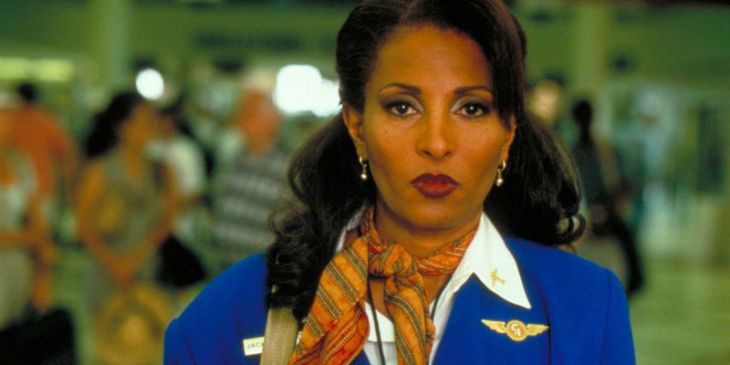
In Jackie Brown, Grier was once again back on top in a leading role. The eponymous protagonist is a flight attendant who feels plucked out of everyday life yet a rockstar in her own right. It’s a powerhouse of a performance, grounding the badass heroines that Grier made a name for. The role was tailor-made for her, with Grier arriving to an audition with Tarantino to find posters of her major films in his office. Assuming that they had been recently placed there, it was a shock to discover that he had been debating taking the long-standing posters down before her arrival.
It is always heartening to witness an unsung performer from decades prior receive a role worthy of their talent. 2022 was the year of the comeback, with both Ke Huy Quan and Brendan Fraser knocking it out of the park in their Oscar-winning roles Everything Everywhere All at Once and The Whale. Something no less fortuitous occurs for Grier in Jackie Brown, an achievement in itself when you consider the rest of this stacked ensemble, which includes Samuel L. Jackson, Robert De Niro, Bridget Fonda, Max Forster, Chris Tucker and Michael Keaton.
While Tarantino’s genre pastiches have always made for entertaining viewings, his early films have a light, nimble touch to them that makes it seem as though anything is possible. That is especially true of Jackie Brown, with lengthy sequences where two characters in a room interrogate and try to understand one another. You feel as though anything could happen in these prickly environments, where conflict could give way to agreeableness or meet a sudden, violent end. Love and violence linger in the air in almost all of these scenes, told in a more muted way than any other film in the American director’s oeuvre. In Jackie Brown, animosity is gradually built up, while the blossoming romance between Forster’s Max Cherry and this eponymous protagonist is surprisingly tender.
Tarantino has talked at length about his desire to direct ten masterpieces, with his oft-discussed final film having been pushed back on numerous occasions, since his scripts haven’t lived up to the director’s grand vision for his final cinematic statement. Frankly, all of this talk has become a tiresome bore. At his best, Tarantino let his characters marinate in their environment, trusting his sharp, scintillating screenplays to provide levity and tension. In Jackie Brown, it is a pleasure to hang out with the film’s wise-cracking figures for two and a half hours.
