
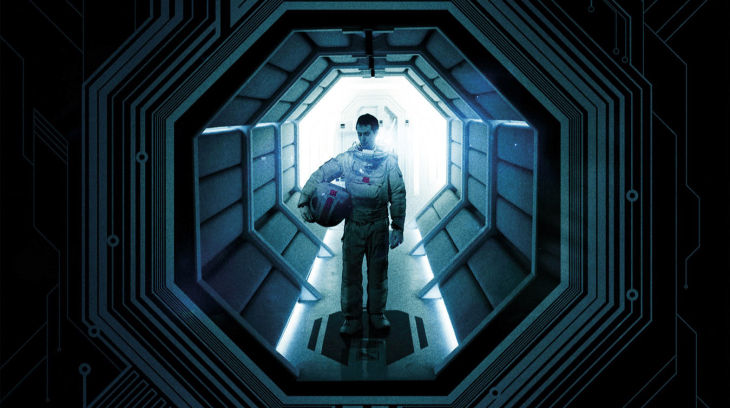
On the surface, you’d probably think Duncan Jones’ (AKA son of David Bowie, AKA Zowie Bowie) Moon is just a low-budget 2001 knockoff made decades later. But in all honesty, it’s really more an homage to sci-fi films of that era and less of a rehash. There are key visuals that immediately remind me of older sci-fi films. It is obvious that the interior design of the lunar station is highly influenced by the ships from 2001 or Alien, and the station itself even has a scaled-down HAL 9000 or Mother, named GERTY that is more mobile and can move around the station to perform tasks when needed. It’s these little things that draw you into the film immediately. They are familiar enough to make you nostalgic for the films you know and love so much.
The Set Up
Here’s the gist of the film, per Google (possible spoilers for those who haven’t seen it):
“Astronaut Sam Bell’s (Sam Rockwell) three-year shift at a lunar mine is finally coming to an end, and he’s looking forward to his reunion with his wife (Dominique McElligott) and young daughter. Suddenly, Sam’s health takes a drastic turn for the worse. He suffers painful headaches and hallucinations, and almost has a fatal accident. He meets what appears to be a younger version of himself, possibly a clone. With time running out, Sam must solve the mystery before the company crew arrives.”
I mean that alone, I’m all in. It’s just so damn intriguing. I love a good old fashioned mystery set in space, especially starring one of my favorite actors, Sam Rockwell. I also just love a good old fashioned.
K.I.S.S. – Keep It Simple Stupid
One of the major things I love about this film is how it looks and feels more like an old-fashioned sci-fi movie in all the best ways. It is more of a psychological drama than anything else. CGI is used minimally (as it should) to hide mistakes such as wirework that pulls the vehicles and enhance things, like adding lens flares, dust plumes, or extending the horizon. All of the scenes that show the moon are made up of miniatures, including the vehicles. And to tie it in even more to the old sci-fi films I mentioned earlier, Duncan Jones even hired prop designers from films such as Alien and Outland to create the miniature models.
It’s a nice change of pace from so many modern movies that just film on green screens and create everything digitally. It helps keep the film grounded and more realistic. And don’t get me wrong, I love a good CGI-fest, but I also appreciate the skill and technique used before CGI took over the world. Just check out this YouTube video about the miniatures used in the film.
Another prime example of something simple that evokes feelings bigger than expected is Clint Mansell’s outstanding film score. It is almost a character in and of itself. I remember watching the movie in the theater and just being drawn to the music as much as the visuals.
Oh, The Humanity
I’m a big fan of movies with one-man or minimal casts like this. Locke, Buried, etc. all draw you in with a similar concept, but play out in very different ways. While it may be hard to keep an audience entertained with only one actor, it is a challenge any good actor has to overcome to really bring the film some real humanity to it. While this film and the others mentioned are not entirely one-man films, they come pretty damn close. On top of some just stellar acting, the film also needs great visuals and an intriguing story to keep you glued to it. Otherwise, it’s just a waste of time.
Moon succeeds on all of these levels. With a lesser star, subpar FX, and a weak story, who knows what might have been? And sure, that is easy to say about most films. But Sam Rockwell’s performance in this film brings all the gravitas to the role. He’s the quintessential everyman (who got to go to space). You relate to him. You feel for him. You care about what happens to him. And honestly, this may be one of the biggest Oscar snubs, because the man deserved a nomination, without a doubt.
And say what you want about Kevin Spacey because of his real-life exploits, he really does a great job as the monotone artificial intelligence assists with the base’s automation and is there to support Sam when he needs it mentally.

The Exploitation of Man
At the center of it all, Moon is a film about the exploitation of labor. An oil crisis in the near future nearly destroys humanity, but like we always do, we recover. But the negative to that is that a large corporation, Lunar Industries, swoops in to oversee the product that will keep us all safe with a fusion-based energy source (helium-3) derived from the soil of the moon. Here in lies the rub… while the lunar mining station is almost fully automated, a human being needs to be present for maintenance and repairs.
One man, trapped on the moon alone. What can go wrong? While it may only be a three-year stint, the job itself has physical and mental effects on a person that could ruin them for life. Of course, the global corporation in charge of it all has a solution for that too. They always do, and you know it can’t benefit the worker in any way.
Legacy
Duncan Jones’ first foray into feature-length films is a fantastic psychological drama. One that manages to blend the sci-fi of old and new in a way that feels fresh without relying heavily on nostalgia. It belongs right along with films like Alien, Silent Running, 2001: A Space Odyssey, or Solaris. A small-scale film that feels like something bigger. And while Jones follow-up films didn’t grasp me quite the way this one did, I will say Mute; his pseudo-Blade Runner-esque film does live in the same universe as this one, and I think it got too much hate when it was released.
What Moon Means to Us
I love when a movie surprises you in a positive way. When it’s better than you expected. Moon surprised the hell out me. I hadn’t heard anything about it (even finding out that the director is David Bowie’s son is something I just earned from reading Al’s article above). I saw it was a Sam Rockwell sci-fi film and decided to give it a shot. It immediately grabbed me with the set design, and the performances and script did the rest. It’s a smart film that does a lot with a little – the budget was something like $5 million – and punches way above its weight class. It’s one of those films that’s kinda about what it means to be human, but it’s not preachy. Al mentions 2001, but what the film most reminded me of was Silent Running, a cool little sci-fi film from 1972 (I think GERTY even kinda looks a little like the little droids from that film). Now I’m just rambling. Come for the classic sci-fi feel, stay for the excellent performance by Sam Rockwell, and enjoy a really good film, well made.
–Bob Cram
If you’ve spent any amount of time here at SAW, you’ve probably heard me argue for smaller genre films that lean less on SFX and more on character and plot. In an era where all of 12-year-old me’s wildest dreams seem to have come true in terms of science fiction and fantasy movies and TV, it’s a real bummer that I couldn’t care less about most of it. To me, the problem is obvious: scale the budgets back, focus less on spectacle and more on giving us stories and characters that resonate with us.
One of the better examples of this in recent memory is Moon. Moon tells a compelling story about a character that we can empathize with. Over the course of the film, we come to care about him and his story. The focus is tight. The acting is superb. The SFX are used sparingly but look gorgeous. Moon is a throwback to movies like Alien and Silent Running and Outland, and it’s everything I want in a sci-fi movie.
–Billy Dhalgren
Tell me what you think of Moon down in the comments below!
