
The New York Times just recently published its list of the best films of the 21st century and while the list itself is solid, it left out dozens of unforgettable films that have defined cinema in the past two decades—bold experiments, overlooked gems, cult classics, and masterpieces that slipped through the cracks of critical consensus. Since it was a collaboration of 500 artists working within Hollywood, only the most prestige titles made the cut, which normally would be fine if it wasn’t for the fact that they had a quarter of a century to pull from. It’s impossible to whittle 25 years down to 100 titles; there were bound to be omissions. Some were baffling, others understandable, but all left us wondering: What about the rest?
This list isn’t a rebuttal—it’s a celebration of what got missed. These are the movies that pushed boundaries, built worlds, broke hearts, or simply did something unforgettable. Some were box office flops, others award-season darlings. Some changed genres, while others created their own. All of them, in their own way, helped shape the cinematic language of the 21st century.
These are the 100 Best Movies of the 21st Century (That Didn’t Make The New York Times’ List).

80. Land of Mine (2015)
Land of Mine takes place in Denmark in 1945, just days after the Nazis surrendered. The beaches are littered with landmines (millions of them) planted by German soldiers who are now prisoners. Or, more precisely, teenage POWs. Now that the war is over, they’re tasked with clearing them all by Danish Sergeant Rasmussen (Roland Møller). Not with special tools or equipment, they’re forced to dig them out by hand. Hitchcock once broke down the difference between surprise and suspense using a bomb as the ultimate example. Surprise is when a bomb explodes under a table, shocking the audience with no prior knowledge. The audience experiences a brief moment of surprise. Whereas suspense is showing the audience the bomb beforehand, and they see the clock ticking down. The characters are unaware, and the audience is left in agonizing anticipation of the impending explosion.
By that logic, Land of Mine is the most suspenseful movie ever made because not only is the audience and the characters aware that there is a bomb, they both know an explosion is inevitable. There is no deus ex machina to save these children. Some of them are going to explode, it’s just a matter of when. But the film doesn’t exploit its premise for tension—it uses it to humanize. Each explosion is a punctuation mark in a sentence about loss. You learn their names. You learn their fears. You start to hope they’ll make it. And that hope is a dangerous thing in a minefield. Land of Mine doesn’t give you heroes. It doesn’t give you villains. It gives you children conscripted into a war they didn’t understand, punished by men who no longer know how to stop fighting. It asks what justice looks like when vengeance wears the same uniform as duty.

79. Persepolis (2007)
Adapted from the director’s own autobiographical graphic novel, Persepolis tells the story of Marjane, a precocious child raised by a progressive family in Tehran during the fall of the Shah and the rise of the Islamic Republic. In another director’s hands, this would be an educational film, maybe even a political one. But Satrapi isn’t interested in teaching you. She’s telling you what it felt like. She filters the collapse of a country through the eyes of a girl who just wants to grow up—read Iron Maiden lyrics, fall in love, speak freely, be angry without being punished for it. Marjane is fiercely proud of her heritage and completely at odds with what her country becomes. She’s funny, furious, brilliant, self-destructive, and real.
You don’t watch her life unfold—you feel it unravel. In exile, she loses herself. In return, she can’t find home. This is not a film about Iran. It’s about memory. About how it feels to live between histories, your country’s and your own. The animation is stark black-and-white, but never simple. The lines are elegant, but the truth is jagged. The beauty is deceptive. Like memory, it erases detail and heightens emotion. It turns tanks into shadows, protests into ghosts, and childhood into something fragile. Persepolis is political, yes. But it is far from propaganda. It cares more about the dangers of extreme ideology and the profound weight of loss. It doesn’t just condemn the regime—it mourns what was stolen from an entire generation: joy, innocence, possibility. It’s not nostalgic. It’s not bitter. It’s just honest.

78. The Handmaiden (2016)
There are films that seduce you with story, and then there are films like The Handmaiden—films that lie to your face, bite you on the neck, and steal your watch while you’re distracted. The Handmaiden is a confidence game dressed as a gothic romance, wrapped in an erotic thriller, dipped in jet-black comedy, and sealed in lacquered decadence. It’s three films in one, and each one is sharper than the last. Loosely based on the novel Fingersmith but transplanted to Japanese-occupied Korea in the 1930s, the plot is pure grifter’s poetry: a con man enlists a street thief to pose as a handmaiden to a wealthy Japanese heiress in order to manipulate her into marriage and steal her fortune. But what starts as a long con morphs into something else. A betrayal. Then another. Then another. And then love. Like all con man stories (and love stories, to be honest), the film is spinning multiple plates, all representing a different thing.
One plate is the grift, one is eroticism on fire and three are different types of stories: the ones we’re told, the ones we perform, and the ones we weaponize. Every character is playing a role, every truth is staged, every desire is part of a script. Until someone rips the pages. In addition to the twisty turvy plot, the film is impeccably photographed. Every frame is immaculate, every camera move feels like a pickpocket, always one step ahead of you. But the plot and style would mean nothing if the love story didn’t land. The chemistry between the two leads doesn’t just burn—it devours. Their love scenes are hotter than anything you’d find in 50 Shades of Grey, they stop just shy of porn. Not the gratuitous kind, but the forbidden desire kind. The Handmaiden is lust wrapped in elegance, cruelty disguised as civility, and revenge dipped in perfume. It’s a love story made of knives and every cut is beautiful.

77. The Host (2006)
Not to be confused with the dumpster fire that is Twilight + aliens, The Host is a Korean monster film that might be the greatest monster film since the original Gojira, depending on your definition of monster. Do the alien slugs from Slither count as a monster or an alien invasion film? Deadly Spawn? Tremors? What about huge ass animals like Night of the Lepus? Whatever your definition is, The Host is probably better. Darkly comedic at times, the film plays sort of like a cross between The Royal Tennenbaums versus a kaiju but not played for laughs. This isn’t a comedy but there is humor. All the characters are well defined but their foibles make for some hilarious moments at times. At its core, it’s a rich character drama with well written characters that could easily fill up five seasons of a TV show but instead of a TV show, they get a huge ass monster and you get an amazing movie.

76. Challengers (2024)
Challengers isn’t just a sports film, nor is it merely a love story wrapped in the world of professional tennis. It’s a simmering, sweat-drenched exploration of ambition, control, and the razor-thin line between love and competition. In its best moments, the film feels like a high-stakes match where emotions, rather than rackets, are the weapons of choice. When the two genres are as strong as a sports movie and a romance, it doesn’t take a master alchemist to smash them together to create gold. There are a million examples of films that have married the two but few do it as well as Challengers. And that’s because none of those other films were directed by Luca Guadagnino nor do they have a cast as hungry as the three leads in this.
Zendaya, stepping into a role that demands both steely determination and raw vulnerability, plays Tashi Duncan, a former tennis prodigy whose career-ending injury forces her to reshape her ambitions. She doesn’t retreat from the game—she evolves within it, molding her husband, Art (Mike Faist), into a champion while maintaining an unresolved, electric connection with his longtime rival, Patrick (Josh O’Connor).
Guadagnino, ever the sensualist, frames this dynamic as something closer to warfare than romance, where desire and strategy are interchangeable. The structure of the film unfolds like a rally, alternating between past and present, revealing layers of history between these three characters. The screenplay by Justin Kuritzkes doesn’t waste time on exposition. Instead, it trusts the audience to pick up on the undercurrents of power, resentment, and longing. The fact that this is his first screenplay is insane, as is the fact that it works as well as it does. In a lesser filmmaker’s hands, Challengers could have been a simple love triangle set against the backdrop of tennis. Instead, it’s something richer, more complex, and infinitely more engrossing.

75. George Washington (2000)
I split the career of David Gordon Green into two categories: his low budget indie dramas I love and his studio films I don’t. Once he made the jump to big budget fare, the quality of the storytelling went down big time. It’s hard for me to fathom how the same director who started their career with a perfect film ended up directing The Exorcist: Believer. George Washington is one of the best debuts any director has ever made and in some ways, he’s never lived up to it. The film explores a group of adolescents in a small, economically depressed town in North Carolina who’s lives change forever when they try and cover up a tragedy. The film’s meditative pace and lyrical cinematography, captured by Tim Orr, create a vivid, almost dreamlike atmosphere that contrasts with the starkness of the children’s realities. The narrative structure is loose, focusing more on character development and mood rather than a conventional plot, which allows for a deeper emotional resonance. It’s a memory piece not unlike The Sandlot but instead of a group of happy-go-lucky baseball enthusiasts going on an adventure, it’s a couple of kids immediately grappling with the reality of death.
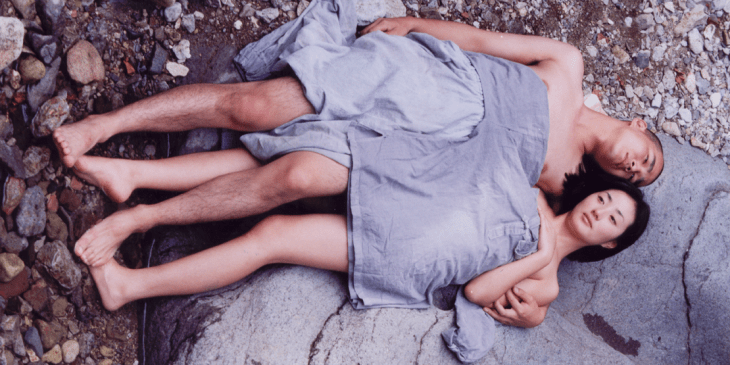
74. Spring, Summer, Fall, Winter…. and Spring (2003)
Despite having one of the most consistent filmographies of any director up until his death, Kim Ki-Duk is never in the conversation of the greatest directors of his generation and I’m baffled as to why. He stayed relatively under the radar his entire career even after this came out and if any movie could catapult a director into the stratosphere, it’s this. Known for its meditative narrative and stunning visuals, Spring, Summer, Fall, Winter… and Spring captures the passage of time and the cyclical nature of life through the changing seasons. The story is set in a small floating monastery on a lake, surrounded by a beautiful forest. The setting itself is a character, with the monastery and the lake reflecting the changes and continuity in life. The narrative is divided into five segments, each representing a different season and stage in the life of the protagonist. The film opens with “Spring,” depicting a young boy being raised by an elderly monk.
As the boy grows up, each subsequent season—Summer, Fall, Winter, and finally, another Spring—marks significant transitions and developments in his life. The film emphasizes the cyclical nature of life, with each season symbolizing a different phase: childhood, adolescence, adulthood, old age, and rebirth. The narrative is deeply infused with Buddhist teachings, particularly the concepts of karma, impermanence, and the search for enlightenment. The protagonist’s journey is a spiritual one, marked by sin, repentance, and ultimately, enlightenment. Few films offer as much philosophical depth and aesthetic elegance as this does. SSFEaS is a profound cinematic exploration of life’s cycles, infused with Buddhist philosophy presented through breathtaking visuals that invites viewers to reflect on their own lives and the universal truths that connect all human experiences.

73. Eighth Grade (2018)
This film depicts the life of a middle school girl with such pinpoint accuracy, that if you told me Bo Burnham was actually a thirteen-year-old girl masquerading as a twentysomething-year-old man, I’d believe you. The protagonist at the center of Eighth Grade (Elsie Fisher) is so well written, so wonderfully developed, It’s hard to believe her story is fictitious. It has all the earmarks of an autobiography but that’s impossible since it deals with life in the age of social media which didn’t exist fifteen years ago.
That and the fact that Burnham, as previously established, is not a little girl. Seeing as how he’s an ex-YouTuber, I get why he knows so much about the all consuming nature of social media but how he knows so much about the teenage girl experience, I have no idea but whatever research he did for it paid off. It’s a brutally honest look at the youth of today that makes no judgments, avoids every cliche in the book and never criticizes or looks down at its subject. Every teenager in it (minus one creep) is handled fairly, there are no bullies that pick on the lead and there’s no prank or scandal that ruins her life. It’s just a film about an awkward teen trying to make it through high school. Which as anyone knows, is hard enough.

72. Election (2005)
Set in modern-day Hong Kong, Election follows the internal struggle for leadership within the powerful Wo Shing Society, the city’s oldest triad. Every two years, tradition demands that a new chairman be elected (not appointed, not seized) elected, by a council of elders. The process is meant to keep violence at bay, to preserve a sense of honor among criminals. But that’s the myth. The reality is far more brutal. This year, two men vie for the top seat. Lok (Simon Yam) is the calm and composed candidate—respected, tactful, and favored by the elders. Big D (Tony Leung Ka-fai), on the other hand, is loud, aggressive, and doesn’t care about tradition. If the votes don’t go his way, he’ll take what he wants with fists and force. At first glance, Election plays like a political thriller dressed in gangster clothes. But To strips away glamour. There are no stylized shootouts here. The violence is quiet, sudden, and disturbing—men beaten with rocks, tortured in back rooms, disposed of without spectacle. Power is ugly, and it’s paid for in blood. Election isn’t about the rise to power. It’s about what that rise costs. It asks whether order can survive in a world built on violence. It shows how democracy can be weaponized (even among criminals) until it becomes just another tool of control.

71. Dogville (2003)
I hardly ever agree with Quentin Tarantino about a movie. I love his passion but he’s recommended so many dogs, I no longer listen to his opinion. One of the few times we’ve ever been in lockstep agreement is on the film Dogville. He’s of the opinion, that if this was a play, Von Trier would’ve won a Pulitzer, and he’s 100% correct. If you’ve turned it off before the ending, I get it. It’s a deliberately paced film (which is code for glacier slow) that has a very weird aesthetic but I promise you, of you stick with it, you’ll be rewarded with one of the greatest endings of recent memory.
Grace (Nicole Kidman) arrives in Dogville, a small, Depression-era American town, and is reluctantly accepted by its residents after some persuasion by Tom (Paul Bettany.) In exchange for shelter, Grace agrees to perform various tasks for the townspeople. Initially, the townspeople are kind and welcoming, but their true nature soon reveals itself as they begin to exploit and abuse Grace. To reveal anymore of the plot would be criminal, so just know it has layers and is always revealing new things in satisfying ways.
The acting is exceptionally good across the board but what separates this from every other film, is there set design. Or lack thereof. notable for its minimalist set design, which resembles a theater stage. The town is represented by an empty soundstage with chalk outlines marking buildings and streets, and minimal props. This stylized approach forces the audience to focus on the characters and the story rather than the setting. The use of theatrical techniques underscores the film’s exploration of human nature and societal constructs. Haters call it pretentious and self-indulgent and I don’t disagree but it’s unique and I always respond to a big swing. I don’t like Von Trier as a human being but goddamn can he make art when he wants to.

70. Paddington 2 (2017)
Live-action films based on beloved children’s properties are almost always garbage. Magic tends to get lost during the transition from page to screen, with few films being able to capture the essence of the book they’re adapting. Fewer still are the ones that somehow manage to retain the magic while also transcending the medium in which they were born. Paddington is amongst the rare examples of an adaptation that’s better than its source material, which makes its sequel doubly amazing, since it’s far better than the first. With its brighter-than-bright colors and fantastical realism, the film, while not entirely Wes Anderson-esque, has a visual style definitely inspired by the quirky director. In addition to its gorgeous color palette and storybook charm, the movie is effortlessly charming and legitimately funny, the latter of which solely belongs to Hugh Grant, who’s never been better as the hilariously inept villainous thespian. Paddington 2 is better than a hundred marmalade sandwiches.

69. It Follows (2014)
Over the years, we’ve seen many a filmmaker try and fail to take over the mantle of their idols. The late 90’s was littered with Tarantino wannabes, this last couple of years has been plagued by 80’s inspired nostalgia porn by Spielberg worshippers and god knows we have enough Hitchcock devotees but David Robert Mitchell is the first director in a long time that’s come close to not only matching his inspiration but one upping him. It Follows perfectly captures the style and tone of a John Carpenter film. While every other director was focused mainly on the more action-y aspects of his work like Robert Rodriguez or merely ripping him to make another Halloween knockoff, Mitchell was the first to tap into the feel of his films.
Every element is designed to invoke the unmistakable feeling of a Carpenter film. From the unforgettably haunting score, which sticks with you long after the film has ended. It’s unrelenting tension – every scene seems to be created to cultivate as much dread as humanly possible. The cinematography, everything shot is designed to put the viewer on edge and it’s unique, bone chilling premise that weaponizes sex and will make you afraid of anyone slowly walking towards you in the same direction. The film bottles the magic of Carpenter while also surpassing him in many ways. The gauntlet has been passed.

68. The Brutalist (2024)
The Brutalist isn’t for everyone. It’s not popcorn, It’s concrete. It’s a cold, impenetrable film that isn’t trying to entertain so much as perform an autopsy. It’s the corpse of the American dream, dressed in Bauhaus minimalism, and embalmed in cello strings. It’s beautiful in the same way Stalinist architecture is beautiful—bleak, rigid, authoritarian, and absolutely hypnotic. At 3.5 hours, it feels like an adaptation of one of the great American novels you’d have to read in high school for a book report you’d inevitably get a C+ on. You’d get all the plot points correct but fumble the themes. Not because you didn’t get it but because there’s so many of them.
There’s Art vs. Capital: (László wants to build monoliths of meaning; the world wants diners and strip malls), assimilation (you can escape fascism, but you can’t escape compromise) and memory as a cage (everyone’s stuck in their own echo chamber. Nobody escapes the past). It says so much, but ultimately feels hollow. None of its themes hit as hard as they should but its ambition and especially the performances, outweigh any flaws. Adrien Brody once again proves he’s one of the best working today.
He plays László Toth, a Hungarian-Jewish architect who survives war, exile, and history, who gets a once-in-a-lifetime opportunity to create something special and realizes too late that the price is making a deal with the devil. The devil in question is played by Guy Pearce, in a sharp suit and in a performance that’s channeling actors of the past such as James Mason, John Huston or Burt Lancaster. In any other movie, he’d be the lead but framing him as this electrifying presence on the outskirts of the frame, gives him more power than anyone else in the movie. So much so, that when he’s not on screen, you miss him. Which makes his villainy that much more surprising. I can see why it didn’t make the NYT’s list, it’s a gargantuan beast you have to reckon with that doesn’t play nearly as well at home but there’s also nothing else like it.

67. All the Beauty and the Bloodshed (2022)
A documentary about an artist who made her trauma into art and then made that art into a weapon. A film that doesn’t flinch. Doesn’t blink. Doesn’t compromise. All the Beauty and the Bloodshed is the kind of documentary that sucker-punches you while gently holding your hand. Laura Poitras (the documentarian behind Citizenfour) teams up with legendary photographer Nan Goldin to crack open the rotting core of American pain (art, addiction, and activism) bleeding out something raw, something brutal, something beautiful. The film swings back and forth between two timelines like a pendulum counting down to a reckoning: her early years documenting queer subcultures, the HIV epidemic, abuse, and drug use, and her modern war against the Sackler family, the billionaire plague rats behind the opioid crisis. It’s a dual portrait: one of a nation’s failure and the other of a survivor’s fury.
Goldin isn’t just the subject, she’s the skeleton key. Her journey unlocks two wildly different fights that ultimately reveal the same enemy: the uncaring rich. The same galleries that showcase Goldin’s work once took blood money from the same people who nearly killed her. Through her story (and the editing that cuts like broken glass), we find out how the rich launder their legacy through museum wings while the poor overdose in public bathrooms. Goldin and her group, P.A.I.N. (Prescription Addiction Intervention Now), crash fancy dinners, stage die-ins, and force institutions to reckon with complicity. And slowly—miraculously—it works. She uses her legacy to shame them out of the halls of culture. Protest becomes performance art. Art becomes protest. It’s all intertwined like veins filled with both heroin and fire.

66. World of Tomorrow (2021)
A heady mixture of sci-fi tropes and philosophical concepts, World of Tomorrow is Hertzfeldt’s most ambitious project yet; which is saying a lot considering he made an entire short examining the meaning of life. Emily is an infant from the present day who meets an adult clone of herself from the future. The malfunctioning third generation clone time traveled for two reasons: 1) To tell the extremely disinterested child what life will be like in about 100 years and 2) To retrieve a memory from the child the clone can no longer remember. Hertzfeldt’s vision of a world made up of scientifically created orphans, human life cycle as an art exhibit and romantic entanglements with a rock, is the most cerebral and profoundly moving depiction of the future I’ve ever seen.
It is such a beautifully made story, that it made my list of the greatest films of the 2010s before it was even finished. That’s how much I loved it and now that it’s finally complete, I feel vindicated putting it as high as I did. The sequels expand the concept in wildly original ways. Part two is called The Burden of Other People’s Thoughts and it once again involves a clone of Emily but this time, she’s visited by a different clone and the journey they go on involves memories, half remembered ideas and ghosts of the subconscious. The third episode, titled The Absent Destinations of David Prime involves the future husband of a clone of Emily’s that doesn’t exist yet visited by a future clone of hers to active a memory of his she implanted when he was born. Time travel and clone shenanigans ensue. The World of Tomorrow is Hertzfeldt’s masterpiece and remains a singular vision of the future that’s unlike anything else in sci-fi.

65. La La Land (2016)
An unfortunate case of life imitating art, the incident at the Oscars (in which a presenter read the wrong envelope and mistakenly gave La La Land the Best Picture Oscar) turned this film’s ending into a self-fulfilling prophecy. Damien Chazelle’s follow-up to Whiplash is a loving homage to the song and dance love stories of old. Where Hollywood was magical, everyone was beautiful and the world was lit in Technicolor. His primary influences were The Umbrellas of Cherbourg and New York New York, which is evident in its look and bittersweet tone. Make no mistake, this film is a love story but it’s also a story about unhappiness. The film builds to a finale in which everyone gets the happy ending that they want but just like La La Land in real life, maybe things would’ve turned out better if the right thing was said at the right time.

64. Paprika (2006)
You ever have a dream so vivid, so strange, so utterly unhinged that you wake up sweating, mumbling nonsense, and questioning the very fabric of reality? Now imagine that dream shoved into a shotgun, along with circus imagery and reality warping elements, and it being pressed against your eyeballs by the mad genius Satoshi Kon who then fires till the gun goes click. That’s Paprika—a film that doesn’t so much tell a story as it kidnaps your subconscious, slaps it awake, and dares it to make sense of the chaos. The film is a kaleidoscopic head trip wrapped in a detective story, dipped in philosophical musings, and sprinkled with a little “what even is identity?” seasoning.
The plot (which is really just a trampoline for the visuals to do cartwheels off of) revolves around a machine that allows therapists to enter people’s dreams—think Inception, but by way of Salvador Dalí and Yayoi Kusama. Our guide through this madness is Dr. Atsuko Chiba, who moonlights in dreamland as the titular Paprika—a manic pixie dream therapist with a voice like a lullaby and the energy of a Red Bull overdose. She’s a glitch in the Matrix, a walking contradiction: simultaneously in control and completely unmoored. She’s not a character, she’s a vibe, and Kon lets her run wild across one of the most visually bonkers landscapes ever animated.
Dreams bleed into reality, reality dissolves into dreams, and logic is left tied up in a closet somewhere while a marching band of frogmen, refrigerators, and disembodied dolls parade through Tokyo like a fever dream on meth. There’s no “what does this mean?”—only how does it make you feel? And that’s where Kon flexes the hardest. He weaponizes animation not just to entertain, but to destabilize you. He wants you to feel lost. He wants your brain doing somersaults. And he absolutely nails it. Due to his unfortunate passing at the young age of 46, this would end up being his last movie, but he went out with a bang.

63. Fahrenheit 9/11 (2004)
Like all of Michael Moore’s films, Fahrenheit 9/11 is a middle finger dressed as a film, that’s aimed squarely at the post-9/11 war machine and the people who greased its wheels. It’ll piss you off, make you laugh, and then punch you in the gut when you least expect it. Released in 2004, Fahrenheit 9/11 landed like a punch to the face at a family BBQ. It was controversial, confrontational, and completely unapologetic. Which, of course, made it essential viewing. Let’s get this out of the way: it’s not a documentary—it’s a Molotov cocktail filled to the brim with gasoline, designed to burn it all to the ground. A two-hour fireball of righteous indignation aimed straight at the heart of American complacency.
If subtlety were a virtue, Moore punted it into the sun and then filmed himself flipping it off on the way back down. This is Moore at his most theatrical, his most sarcastic, his most… Moore. He weaponizes irony like it’s a goddamn superpower. He shows us grainy footage of Bush reading The Pet Goat during the 9/11 attacks like he’s auditioning for a role in Clueless. He juxtaposes explosions with “What a Wonderful World” like Kubrick got drunk and started making campaign ads. And through it all, Moore narrates with the tone of a disappointed uncle who told you this would happen but you didn’t listen, did you? But here’s the kicker—beneath the cheap shots and snark, Fahrenheit 9/11 works.
It stings. It stabs. It bleeds truth, or at least Moore’s version of the truth, and whether you agree with it or not, it forces you to look. At the fear. At the manipulation. At the cost of war, paid not by politicians but by kids from Flint, Michigan, who joined the army because they had no other options. Is it propaganda? Absolutely. But it’s propaganda with a pulse. A heart. A purpose. Moore isn’t pretending to be objective—he’s dragging the American empire into the light with a spotlight made of rage and patriotism duct-taped together. And whether you think he’s a hero or a hack, you can’t deny the impact: Palme d’Or at Cannes, highest-grossing doc of all time, and a generation of Americans suddenly side-eyeing their government like it just farted in church.

87. The Good, the Bad, the Weird (2008)
Set in 1930s Manchuria, The Good, the Bad, the Weird is a wacky Korean take on the spaghetti western formula. It follows three main characters, each with vastly different personalities, as they get caught up in the hunt for a map that leads to a mysterious treasure.
The Good is a bounty hunter, out to track down the Bad, an evil hitman. Lee Byung-hun makes a rare appearance as an antagonist playing ‘The Bad’ of the trio, and he comes across like an evil character from a 90s Japanese video game (which is a compliment by the way). The Weird is a wildcard that manages to get himself caught up in the mayhem. Played by Song Kang-ho, he is the highlight and provides lots of laugh-out-loud moments. The cinematography is top-notch, and the future retro aesthetic works perfectly. Add to this some great action and spectacular set pieces, leaving you with fantastic entertainment from start to finish.
–Lee McCutcheon

61. Knives Out (2019)
Clearly inspired by the work of Agatha Christie, Knives Out is an entertaining homage to the murder mysteries of old. There’s a dead body, everyone associated to the deceased has motive (except the teenager son, who serves no purpose) and at the center of it, is an over the top detective (a career best Craig) who was hired by a mysterious benefactor to determine whether it was a suicide or murder. It’s all standard boiler plate murder mystery shit but it’s how Johnson uses those cliches and tropes that separates it from everything else. The red herrings are all great, the film doesn’t cheat the reveal (all the clues are there from the beginning) and the final reveal is satisfying. You’ll laugh, you’ll exclaim AH-HA! at least a dozen times and then you’ll immediately head to Amazon to buy a sweater that looks even remotely close to the one Chris Evans wears in this.
100-81 | 60-41
Were you surprised by which movies made (or didn’t make) The New York Times’ list? Do you agree with my selection of picks so far? Let us know in the comments below!
