
The Academy isn’t just a couple of guys who watch every movie released within a year. It’s a collective of over 10,500 global film industry artists and leaders, so there’s bound to be wildly varied opinions on what is and what isn’t nomination-worthy. What one person considers great, another might find pandering and vice versa. That’s why in the nearly 100 years the Academy has been in existence, they’ve messed up as many times as they’ve gotten it right. The amount of iconic directors who were overlooked, big screen superstars who were ignored, and all-time classics that received no love is so big, they form an unofficial group called the “Snub Club.” Honorary members include Alfred Hitchcock, Stanley Kubrick, The Shawshank Redemption, Charlie Chaplin, E.T. the Extra-Terrestrial, Glen Close, Saving Private Ryan and many, many others. After the list of 2024 nominees was revealed, The Snub Club received two new members: Greta Gerwig and Margot Robbie for Barbie. The internet was so incensed by their lack of nominations that it completely dominated the conversation. While shocking, it’s not that surprising considering the strength of that year. They weren’t snubbed, there was just a glut of talented directors and actresses that year. This list will highlight true snubs that should’ve gotten a nom (and probably should’ve won) but didn’t.
These are the 100 Biggest Oscar Acting Snubs of All Time.

40. Natalie Portman | Léon: The Professional (1994)
In 1934 at the age of six, Shirley Temple was awarded the first ever Academy Juvenile Award, a separate prize created to recognise young actors’ capabilities separate from the main Oscar categories. Almost thirty years later, they eventually discontinued it when Patty Duke won at the age of sixteen convincing the Academy that young actors could successfully compete against seasoned veterans. A handful of young actors have been nominated since Duke’s victory but there have only been two young winners – Tatum O’Neal in 1974 and Anna Paquin in 1994. If I had it my way, there would definitely be one more: Natalie Portman in Leon: The Professional. At just twelve years old and with practically zero acting experience to her name, Portman delivers a nuanced performance far beyond her years that elevates the character beyond the typical child role. From the moment Mathilda’s family is brutally murdered, she skillfully conveys the grief and trauma, setting the tone for her character’s complex journey. Her chemistry with Jean Reno, who plays the titular hitman Leon, is amazing (although slightly problematic after the recent allegations against the director have come forward), creating a unique bond between two characters from vastly different worlds. Portman navigates Mathilda’s emotional spectrum with a depth that is remarkable for her age, capturing the essence of a girl forced to mature prematurely in the gritty underworld of hitmen. All three central performances are great in their own right (Oldman has rarely been better and Reno has literally never been better) but the film wouldn’t work if the child at the center of it wasn’t good. Besson either would’ve had to age the character up, change it to a boy to widen the search or would’ve had to settle for an ok actor if Portman wasn’t born.

39. Boris Karloff | Frankenstein (1931)
Frankenstein’s creature (or monster, whatever you prefer) is instantly identifiable by almost everyone in the world, has been in the public consciousness for almost 100 years and is massively influential to both horror and sci-fi. With his gaunt appearance, sunken eyes, big ass boots and trademarked flat top head and neck bolts, every element of his design is iconic. Jack P. Pierce’s make up was groundbreaking but it would’ve been for naught if it was applied to any other actor. Shelley might’ve given him life but Karloff gave the monster a soul. Unlike his contemporaries, Karloff didn’t play him as a one note, lumbering zombie. He added a child like innocence to him, which is all the more tragic after he accidentally murders a little girl. Even still, you never lose sympathy for him because he never asked to be born again. He’s hated simply because he’s different, which is something far too many of us relate to. If you want definitive proof that the Academy straight up hates horror, look at the movies they nominated that year and count how many of them you’ve actually heard of. Two horror performances should’ve been nominated (this and Frederick March from Dr Jekyll and Mr Hyde) and the movie itself should’ve been nominated in every category. The only movie that year that could’ve shut it out was also not nominated. What the fuck were they doing in 1932?

38. Cary Grant | North by Northwest (1959)
In 1999, the American Film Institute named Cary Grant the second male star of the Golden Age of Hollywood cinema right behind Humphrey Bogart. It’s hard to say which actor had a bigger impact or who had the better films but it is clear who the Academy favored. If you count Grant’s honorary Oscar, they technically have the same amount of nominations and wins but the difference between the two, is that you can probably guess which movies Bogart got them for. Out of the many all-time classics Grant made, it would be Penny Serenade and None but the Lonely Heart that would garner him his only noms. The former makes sense because it’s an affable romantic comedy which he excels at but the second doesn’t at all. He plays a troubled cockney youth despite being nearly forty when he made it.
He’s given much better performances in much better movies, all of which could’ve netted him a nom. It’s hard to pick which one stands above the others but if I had to pick, I’d say North by Northwest is the best use of his talents. As Roger O. Thornhill, Grant navigates the film’s intricate plot with impeccable style, delivering a character that has become synonymous with the sophisticated leading man of classic Hollywood cinema. He oozes suave charm and effortless charisma. From the opening scenes where Thornhill is mistaken for a government agent and thrust into a web of espionage, Grant captivates the audience with his wit and debonair demeanor. His ability to balance humor with a sense of danger adds layers to the character, turning Thornhill into more than just a hapless victim caught in a spy thriller. I truly believe his persona and his on-screen chemistry with his costar Eva Marie Saint, which is dynamite, laid the groundwork for James Bond and set the template for every action lead that came after.

37. Denzel Washington | Philadelphia (1993)
In an article on Denzel Washington in the Irish Times, Tom Hanks heaped effusive praise on the actor essentially calling him a one man film school. Watching his costar in the film Philadelphia was an acting class and Hanks took nothing but notes. He credits Washington for making him a better actor and considers this to be one of the highlights of his career. Which makes it all the more bizarre that it received no love from any major award shows. In the film, Washington portrays Joe Miller, a skilled and initially reluctant attorney who takes on the case of Andrew Beckett, played by Tom Hanks, a lawyer who is wrongfully terminated due to his diagnosis with AIDS. Washington’s portrayal of Miller is a compelling exploration of personal growth, empathy, and the confrontation of one’s own prejudices.
At the film’s outset, Miller harbors homophobic attitudes, initially hesitating to represent Beckett due to his own ingrained biases. Washington adeptly navigates Miller’s transformation from a lawyer driven by financial gain to a compassionate advocate for justice. The character’s evolution becomes a poignant subplot, adding layers of complexity to the film’s overarching narrative. The chemistry between Washington and Hanks is pivotal in conveying the emotional core of Philadelphia. Their on-screen dynamic evolves from initial discomfort and skepticism to a profound friendship built on understanding and shared humanity. Washington’s ability to convey the internal struggle of a character torn between societal prejudice and a burgeoning sense of justice is a testament to his skill as an actor. In the courtroom scenes, Washington delivers powerful and impassioned speeches that resonate with authenticity. His portrayal of a lawyer grappling with moral dilemmas elevates the film beyond a mere legal drama, turning it into a poignant exploration of human rights and compassion.

36. Charlie Chaplin | City Lights (1931)
This is the other film and performance Academy members decided not to nominate in 1932. This and Frankenstein should’ve taken every single award that year but they thought movies like Skippy, Whoopie! and Min and Bill were more important. C’est la vie. In City Lights, Chaplin reprises his iconic role as the Tramp, a character that has become synonymous with his name. The film follows the Tramp as he befriends a blind flower girl, played by Virginia Cherrill, and embarks on a series of misadventures in the bustling city. Chaplin’s ability to convey a range of emotions without uttering a single word is nothing short of extraordinary. Through his expressive face, physical comedy, and impeccable timing, he brings the Tramp to life with a depth that transcends language barriers. Whether engaging in slapstick humor or navigating moments of heartfelt tenderness, his performance captivates audiences and elicits genuine empathy for his character. Chaplin’s involvement in every aspect of filmmaking, from acting to directing and composing the musical score, highlights his artistic vision and control over his craft. His dedication to preserving the art of silent cinema in the face of a changing industry is commendable and solidifies his legacy as a pioneer in the history of filmmaking. He, along with a couple of notable Oscar-less illuminaries, will forever be the face of the unofficial Snub Club.

35. Gene Hackman | The Conversation (1974)
The Conversation is a suspenseful and underseen thriller that revolves around a meticulous and enigmatic surveillance expert haunted by the moral implications of his work. Hackman brings a quiet intensity to the role of Harry Caul, a surveillance specialist hired to eavesdrop on a seemingly innocuous conversation in a public space. The film delves into the psychological toll of a life spent listening in on others, blurring the line between observer and the observed. Caul’s meticulous nature is reflected not only in his professional life but also in his personal relationships. Hackman’s portrayal captures the isolation and detachment that define his existence, showcasing the character’s struggle to maintain a semblance of control amidst the chaos of his own mind. The film’s narrative is intricately woven, and Hackman’s performance serves as the linchpin that holds it together.
One of the film’s standout moments is the famous saxophone serenade scene, where Caul’s guarded exterior momentarily cracks, revealing a man yearning for connection and understanding. Hackman’s portrayal in this scene is a poignant exploration of vulnerability, showcasing the internal struggle that lies beneath Caul’s stoic façade. Coppola’s decision to cast Hackman in the lead role proves to be a stroke of genius. The actor’s ability to convey depth through silence and restraint allows the audience to project their own interpretations onto Caul’s character, heightening the film’s sense of ambiguity and suspense. In my headcanon, the 1998 film Enemy of the State is a sequel to this with Hackman playing the same character in both. It gives Harry Caul closure and makes that movie ten times better by association.

34. Sidney Poitier | In the Heat of the Night (1976)
Sidney Poitier’s portrayal of Virgil Tibbs in In the Heat of the Night is a pivotal moment in cinematic history. His commanding performance not only anchors the film but also contributes to the broader conversation about racial equality in America during a tumultuous period. Poitier’s legacy as a trailblazer in Hollywood is indelibly tied to his groundbreaking work in films like this, where his talent and presence transcend the screen, leaving an enduring impact on the landscape of American cinema. Poitier portrays Virgil Tibbs, a skilled detective from Philadelphia who finds himself in the racially charged town of Sparta, Mississippi. From the outset, Poitier imbues Tibbs with a quiet strength and intelligence that defies the prevailing racial prejudices of the time. The film opens with Tibbs’ wrongful arrest, a scene that sets the stage for a compelling narrative focused on crime, justice, and racial inequality. One of the film’s strengths lies in Poitier’s ability to convey Tibbs’ internal conflict as he navigates the hostility of the Southern town. Tibbs must grapple not only with solving a murder but also with the pervasive racism that surrounds him. Poitier’s nuanced performance captures the character’s resilience, dignity, and restrained anger, making Tibbs a symbol of the Civil Rights Movement.
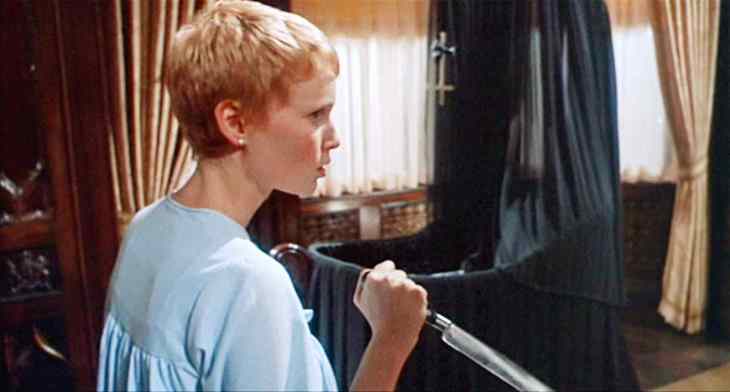
33. Mia Farrow | Rosemary’s Baby (1968)
Mia Farrow’s performance in Roman Polanski’s Rosemary’s Baby is a haunting and iconic portrayal that cements her status as one of the most compelling actresses of her generation. The film is a psychological horror masterpiece that explores themes of paranoia, motherhood, and the supernatural. Farrow takes on the role of Rosemary Woodhouse, a young and vulnerable woman who moves into an ominous apartment building with her ambitious actor husband, portrayed by John Cassavetes. From the outset, Farrow’s delicate and ethereal presence establishes Rosemary as an innocent and trusting character, setting the stage for a chilling descent into psychological torment. The film’s atmosphere is heightened by Farrow’s portrayal of Rosemary’s physical and emotional fragility. Farrow’s waif-like appearance and expressive eyes become a canvas for the audience to witness Rosemary’s deteriorating mental state, making her a relatable and sympathetic figure amidst the escalating horror. The film’s success is undoubtedly intertwined with Farrow’s ability to anchor the narrative, making Rosemary a compelling and enduring character in the annals of horror cinema.

32. Humphrey Bogart | The Maltese Falcon (1941)
I previously mentioned in the Cary Grant write up that the Academy loved Bogart and recognized his work in his best movies but there was one they most definitely should’ve given a nomination to. Humphrey Bogart’s portrayal of the iconic detective Sam Spade in John Huston’s The Maltese Falcon is a cornerstone of film noir and a defining moment in Bogart’s illustrious career. The film is an adaptation of Dashiell Hammett’s hard-boiled detective novel, and Bogart’s performance as the cynical and enigmatic private investigator solidifies his status as a quintessential leading man in the noir genre. From the moment Bogart appears on screen, he exudes a magnetic presence that encapsulates the essence of film noir’s antihero. As Sam Spade, Bogart embodies the classic characteristics of a noir protagonist – a morally ambiguous, wisecracking detective navigating the gritty underbelly of a shadowy world.
His delivery of Spade’s sharp and sardonic dialogue is a masterclass in tough-guy charisma. His ability to convey complex emotions with a raised eyebrow or a subtle smirk adds layers to the character, making Spade more than a mere detective; he becomes a symbol of resilience and pragmatism in a morally murky world. The Maltese Falcon marked a turning point in Bogart’s career, elevating him from supporting roles to leading man status. The film’s critical and commercial success paved the way for Bogart to become a Hollywood legend, and his portrayal of Sam Spade remains one of the most memorable in cinematic history.

31. John Gazale | The Godfather Part II (1974)
Sometimes a movie is so good, it feels like the Academy intentionally snubs some potential nominees just so other actors can get a shot. The Godfather Part II was nominated left, right and center. It dominated that year’s ceremony but there were two major players that were utterly left out of the conversation: Diane Keaton and John Cazale. Lee Strasberg getting the nom over Cazale is 100% an example of the Academy wanting to nominate the man and not the performance. Strasberg is a legendary acting instructor that’s considered the “father of method acting in America” who’s influence and impact are incalculable. That’s why he was nominated. Just so they could give him something. Since it’s a bit part, any actor could’ve done the role justice but very few could be as emotionally fragile as Fredo Corleone. Fredo, the second son of the Corleone family, is a complex character whose internal struggles mirror the intricate dynamics of the Corleone crime family. Cazale brings a poignant vulnerability to Fredo, portraying him as a well-intentioned but meek man overshadowed by his powerful and domineering father, Vito Corleone.
What sets Cazale’s performance apart is his ability to convey Fredo’s inner turmoil through subtle gestures and expressions. Fredo’s desire for approval and acceptance is palpable in Cazale’s eyes, which become windows into the character’s soul. The actor’s nuanced approach humanizes Fredo, eliciting empathy from the audience even as the character’s actions contribute to the family’s internal strife. Despite limited screen time, Cazale’s presence looms large over the film, and his performance resonates beyond individual scenes. Fredo’s tragic arc becomes a microcosm of the larger themes of power, loyalty, and the corrosive effects of the mafia lifestyle. Cazale’s ability to convey the fragility of Fredo’s spirit underscores the film’s exploration of the high cost of ambition and the consequences of familial betrayal. The fraught relationship between Michael and Fredo becomes a central focus, and Cazale’s performance intensifies the emotional impact of the narrative. The climactic confrontation between the two brothers is a testament to the depth of Cazale’s acting prowess, as he captures Fredo’s heartbreak and resignation. He wasn’t on this Earth long but man did Cazale leave an impact.
50-41 | 30-21
What do you think of the selection so far? Which Oscar snubs do you think are the most egregious? Maybe they will show up further on the list!
