
Controversy often serves as a catalyst for discussion, debate, and even dissent. From provocative themes to boundary-pushing visuals, certain films have sparked fervent discourse, challenging societal norms, moral codes, and artistic boundaries. Join us as we embark on a cinematic journey through film history, as we encounter a diverse array of works that have ignited controversy in various forms.
This curated list delves into what we at SAW have determined to be the 100 of the most controversial movies ever made. These films are not merely provocative for the sake of shock value; rather, they offer profound insights into the human condition, societal taboos, and the power of art to challenge, provoke, and inspire. Some have been met with critical acclaim despite their contentious nature, while others have faced censorship, bans, and public outrage.
From groundbreaking classics that pushed the boundaries of cinematic expression to modern masterpieces that continue to polarize audiences, each entry in this list represents a unique chapter in the ongoing evolution of cinema. As we navigate through tales of love, violence, politics, religion, sexuality, and everything in between, we invite you to engage with these films, not only as entertainment but as thought-provoking discussions of art.

10. The Birth Of A Nation (1915)
The Birth of a Nation (originally titled The Clansmen), directed by D.W. Griffith and released in 1915, is a landmark film in the history of cinema. Regarded as one of the most controversial and influential films ever made, it presents a highly problematic portrayal of American history and race relations. Set during and after the American Civil War, the film follows two families, the Stonemans from the North and the Camerons from the South, against the backdrop of Reconstruction. The Birth of a Nation glorifies the Ku Klux Klan (KKK) as heroes and vilifies Black Americans, depicting them as unintelligent and sexual predators. Griffith employed groundbreaking cinematic techniques such as close-ups, cross-cutting, and panoramic shots, significantly advancing the language of filmmaking. However, the film’s racist narrative overshadowed its technical achievements.
Controversy has surrounded The Birth of a Nation since its release, with many condemning its racist propaganda and glorification of the KKK. The film sparked protests and riots in several cities, leading to calls for censorship and bans. Despite its historical significance in advancing cinematic techniques, The Birth of a Nation remains a highly divisive and contested work due to its harmful portrayal of race and its role in perpetuating racist stereotypes. While it undeniably influenced the course of filmmaking, its legacy is marred by its promotion of white supremacy and racial hatred.
-Vincent Kane

9. The Interview (2014)
It’s almost insane in retrospect, but for a hot second about a decade ago, a forgettable James Franco and Seth Rogen comedy almost caused WWIII. The duo play two tabloid journalists who secure an interview with North Korean leader Kim Jong-un. However, their plans take an unexpected turn when the CIA recruits them to assassinate Kim Jong-un. The premise of The Interview drew significant controversy even before its release, as it depicted the assassination of a sitting head of state. North Korea, in particular, condemned the film, viewing it as an act of aggression and launching cyberattacks against Sony Pictures, the film’s distributor. The film’s release became a focal point for debates about freedom of expression, censorship, and the power of comedy to address sensitive political topics. It also raised questions about the responsibilities of filmmakers and studios when dealing with potentially inflammatory subject matter. In the years since its release, The Interview has become a cultural touchstone, remembered not only for its controversial production and release but also for its impact on discussions surrounding media, politics, and the boundaries of comedy. While divisive, the film serves as a reminder of the complex interplay between art, politics, and society in the modern era.
-Sailor Monsoon

8. The Exorcist (1973)
The Exorcist is one of the greatest horror films of the 20th century – hell, of all time. It made people scream and run out of the theater. Rumors abounded of people fainting and throwing up. One woman supposedly miscarried (a throwback to Freaks). There were reports of priests that saw it having crises of faith, and other reports of lapsed Catholics finding renewed faith. You can’t buy that kind of publicity, but Warner Brothers did their best to play up whatever they could that made the film sound dangerous and frightening.
It probably didn’t need the help. Based on the extremely popular William Peter Blatty novel, the film had a read-made audience. Then word of head spinning, pea-soup vomit and crucifix masturbation did the rest. For my money, it’s the medical scenes that cause the most discomfort – that angiography terrified the hell out of me, not the least because it’s something that people actually had to endure.
In addition to all the outrageous scenes, religious controversy and ratings accusations (people accused the MPAA of yielding to pressure to give the film an R rating, rather than an X), the film picked up a reputation as being cursed as well. Cast and crew were injured, including both Ellen Burstyn and Linda Blair, who suffered lifelong back injuries during shooting – and those scenes ended up in the film. There were deaths, fires, and a 10 foot tall statue of a demon disappeared in transit. The woman who provided the voice of the demon was a recovered alcoholic who fell of the wagon specifically so she could do what she needed to in providing the voice.
The Exorcist was arguably the first blockbuster horror film of the modern age. Like Stephen King’s Carrie did for the paperback horror novel, it revealed a hidden appetite for horror movies, and Hollywood was only too happy to oblige, with a slew of similar themed films. While it’s since become a part of our cultural background, a shorthand for things going crazy, the film itself remains pretty powerful and affecting.
-Bob Cram Jr.
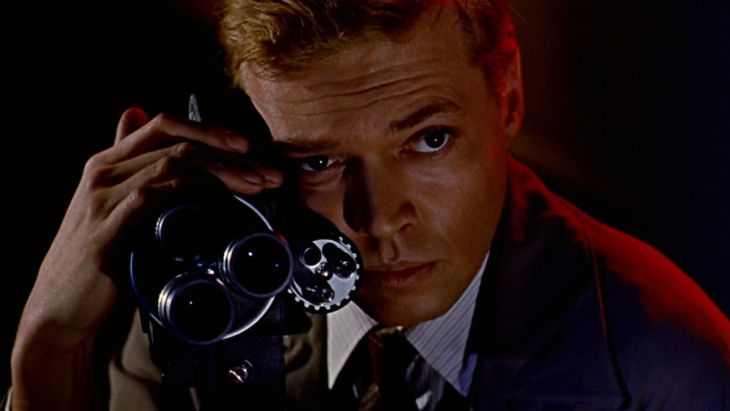
7. Peeping Tom (1960)
Michael Powell’s classic raised questions about the nature of voyeurism and the relationship between cinema and violence as it follows a disturbed young man who murders women while filming their terrorized expressions with a camera rigged with a blade. Critics and audiences were shocked by the film’s unflinching portrayal of murder and its voyeuristic perspective, which challenged traditional cinematic norms.
Even though it was released a couple of months before Alfred Hitchcock’s Psycho, these two films would be intertwined even to this day with Peeping Tom essentially taking the proverbial “back seat” to Psycho. Some would claim that after seeing the negative reactions to Peeping Tom, Hitchcock would skip press screenings for Psycho to avoid similar outrage to his film.
Many would point to Psycho for helping create the slasher genre because of its popularity since Peeping Tom not only faced controversy but also, had a short theatrical run. However, many film historians claim Powell’s film set more of a template for modern slashers by introducing multiple female victims leading to the sympathetic final girl.
-Vincent Kane

6. Crash (1996)
In a daring and provocative exploration of human sexuality, obsession, and the intersection of technology and desire, David Cronenberg’s Crash, ruffled a lot of feathers. Adapted from J.G. Ballard’s controversial novel of the same name, the film follows a group of characters who are drawn to the erotic allure of car crashes and the visceral thrill of danger. Cronenberg’s meticulous direction and the film’s stark, unsettling imagery create an atmosphere of unease and fascination, drawing viewers into a world where the boundaries between pleasure and pain blur. The film’s unflinching examination of taboo desires and its exploration of the darker aspects of human nature challenge conventional notions of sexuality and morality, sparking intense debate and controversy.
Crash provoked outrage and condemnation upon its release due to its explicit depiction of sexual fetishes and its unapologetic embrace of transgressive themes. Critics and audiences were divided over the film’s merits, with some hailing it as a bold and visionary work of art while others condemned it as obscene and morally reprehensible. The film’s graphic scenes of car crash erotica and its exploration of the eroticization of violence pushed the boundaries of cinematic storytelling, challenging viewers to confront uncomfortable truths about desire and the human psyche. Despite—or perhaps because of—its divisive reception, Crash has endured as a cult classic, praised for its audacious vision and its fearless exploration of the forbidden realms of human desire. It remains a challenging and unforgettable cinematic experience that continues to provoke discussion and debate.
-Vincent Kane

5. Pink Flamingos (1972)
Roger Ebert disliked Pink Flamingos so much, he refused to give it a star rating, declaring it not worthy of being called a movie. In 1973, Variety eviscerated the movie calling it “one of the most vile, stupid and repulsive films ever made.” Thirty years later, they named it one of the 100 greatest movies ever made. Television censors made it illegal to watch uncut on TV due to the scene where Divine eats dog shit and now we have shows where people eat nasty shit to win money. Critics and censors hated this movie when it came out but the ones who went back to it years later see just how prescient John Waters was. He correctly predicted the state of pop culture for the next 50 years. We just weren’t ready for it at the time. Known for its provocative and transgressive content and pushing the boundaries of taste and decency, the film centers around the life of Divine, a drag queen, and their quest to maintain the title of “the filthiest person alive” against rivals Connie (Mink Stole) and Raymond Marble (David Lochary). The film is notorious for its shocking scenes, including but not limited to, nudity, sexual content, violence, and explicit language. Pink Flamingos is celebrated for its bold rejection of mainstream norms and its embrace of underground counterculture. It embodies the ethos of the “midnight movie,” attracting audiences seeking unconventional and boundary-pushing cinema experiences. It’s about as close to punk rock as any movie has ever gotten.
-Sailor Monsoon

4. Cannibal Holocaust (1980)
Inspired by the Mondo films of Gualtiero Jacopetti and the violence of the Italian Red Brigades, Ruggero Deodato’s Cannibal Holocaust is a brutal, horrifying, pseudo-found-footage film that purports to be a commentary on civilization vs the primitive, but that somehow contributes to the very exploitation its supposedly criticizing. It features deaths so realistic that Deodato was actually tried for murder of his cast – requiring him to bring in the “missing” crew members to prove his innocence.
In addition to the fake gore and (sometimes) fake brutality on display in the film, there are also the very real animal deaths depicted. A turtle is slaughtered, a pig is shot, and a coati, snake, spider and monkey are all killed on screen. As horrifying as this is, it results in the viewer being unable to distinguish what deaths are real and what deaths are not, providing that sense of realism that caused accusations of it being a snuff film. The director and producer were initially convicted of obscenity, and the film banned. It apparently remains banned in some countries.
I’ve seen the movie twice, and have no desire to see it again. It does too good a job at pretending to be a movie about man’s inhumanity to other human beings and the world around him. It’s grimy, horrifying and too damn realistic. No people may have been harmed in the making of the film (though cast members suffered mental and emotional anguish), but the audience doesn’t make it out of that green hell unscathed.
-Bob Cram Jr.

3. Salò, or the 120 Days of Sodom (1975)
Pier Paolo Pasolini pissed off just about everyone. From his political views, to his homosexuality, to his critical examination of taboo sexual matters, Pasolini’s work and beliefs created enemies. His uncompromising art lead to his brutal end. While it’s not confirmed, it is highly suspected that the nature of his final film drove someone to murder him. Salo, or the 120 Days of Sodom is so powerful, it cost its director his life. Loosely based on the Marquis de Sade’s novel of the same name, the film transposes the narrative to Fascist Italy during the final days of Benito Mussolini’s regime. Set in the Republic of Salò, where four powerful and sadistic Fascist leaders—known as the Duke, the Bishop, the Magistrate, and the President—abduct a group of eighteen young men and women.
These captives are subjected to a series of depraved and dehumanizing acts of torture, sexual abuse, and degradation over the course of four months. It is the first torture porn film in existence. Back when Eli Roth was just a baby, Pasolini was subjecting audiences to extreme violence, sexual brutality, and moral degradation the likes of which they had never seen before. But that was the point. The film’s exploration of power, corruption, and the abuse of authority resonates with broader sociopolitical themes, serving as a chilling indictment of totalitarianism and the capacity for cruelty within human nature.
-Sailor Monsoon

2. The Devils (1971)
Based on the play “The Devils of Loudun”, which in turn was inspired by historical events, the film portrays the hysteria surrounding the supposed possessions of a convent of Ursuline nuns in 17th-century France. Set in the city of Loudun during the reign of Louis XIII, the film follows the story of Urbain Grandier (Oliver Reed), a charismatic and politically influential Catholic priest who becomes the target of the scheming Cardinal Richelieu (Christopher Logue) and Sister Jeanne (Vanessa Redgrave), the sexually repressed and mentally unstable Mother Superior of the Ursuline convent. When the nuns begin to exhibit signs of possession, Grandier is falsely accused of witchcraft and demonic possession, leading to his trial, torture, and execution. Since this Ken Russell, the sexually explicit content and sacrilegious themes are cranked up to 11.
There’s full on crazy nun orgies and one of the Sisters even masturbates with a bone. Many countries heavily edited or banned the film outright, deeming it unfit for the public. To this day, an unedited version of this is exceedingly rare. Despite the controversy, the film has gained a cult following over the years, admired for its daring approach to exploring the intersection of power, religion, and sexuality. Some even go so far as to say it’s one of the best movies of the decade, full stop. The Devils remains a polarizing and divisive work, sparking debates about censorship, artistic freedom, and the boundaries of acceptable content in cinema. Its legacy endures as a testament to the provocative and confrontational nature of Ken Russell’s filmmaking and the enduring power of challenging and subversive cinema.
-Sailor Monsoon

1. Song of the South (1946)
The most controversial movie of all time doesn’t include real death or explicit sex or extreme subject matter, it’s a Disney movie that’s aged significantly since its release. As bad as every other movie on this list is, they’re still available. There’s nothing stopping you from watching A Serbian Film or Sàlo but Disney has made it all but impossible to find Song of the South. Every once in awhile, a shitty VHS rip will end up on YouTube but unless you’re willing to sail the pirate seas of the Internet, you can’t watch this movie. It has never and will never receive a DVD or Blu-ray release and Disney refuses to put it on their streaming service. They’re even removing it from their theme park and replacing it with Princess and the Frog. They want everyone to pretend this thing doesn’t exist, which is a shame because it’s actually a great movie.
Blending live-action with animation, the movie is set in the Reconstruction Era South and follows the adventures of a young boy named Johnny (Bobby Driscoll), who befriends Uncle Remus (James Baskett), a former slave who tells him stories featuring the animated characters Br’er Rabbit, Br’er Fox, and Br’er Bear. Critics argue that the film romanticizes the antebellum South and perpetuates racial stereotypes, particularly through its portrayal of the African American characters. The character of Uncle Remus has been criticized for embodying the “happy slave” archetype, and the film has been accused of whitewashing the realities of slavery and its aftermath. I can’t argue against that stance but I can say that erasing this from history also erases Baskett’s Oscar winning (it was an honorary Oscar but still) performance. That’s a significant win for history and a great performance that generations don’t get to see. They also won’t get to hear the incredibly catchy music such as Zip-A-Dee-Doo-Dah. All Disney needed to do was release it with an intro explaining that times have changed and the film has potentially offense material in it. That’s it. But since they refuse to release it, they kept the controversy alive forever.
-Sailor Monsoon
20-11 | Rewind?
How many of these controversial movies have you seen? Did you find any of them controversial?