
Since birth, we’ve been indoctrinated with a love of horror, whether we knew it or not. The first game your mother would play with you involved her hiding behind her hands and then shouting, “Boo!” We would get taught folk tales that involved a witch wanting to eat children or a wolf wearing the skin of an elderly woman. Some of us were warned of the Krampus, who’d kidnap misbehaving little boys and girls. We’d play Bloody Mary and watch old Disney films. You know, the scary ones. It was a lifetime of preparation for horror. Because deep down, we all have an innate desire to be frightened. We crave it and these characters scare us better than any others. Since this list encompasses the entire history of horror, every genre (and subgenre) is represented. Everything from creature features to kinder trauma, action movies to horror comedies are eligible. I combined characters if they worked as a duo or a group and I excluded animals (save for one) unless they were supernaturally possessed or if they had an internal monologue so that we could understand their motivations. I also only included characters from thrillers if they targeted children. This list is a celebration of horror and the icons that help us lose sleep at night.
These are the 500 Greatest Horror Characters of All Time.

150. Coffin Joe (José Mojica Marins) | Coffin Joe Trilogy (1964-2008)
Coffin Joe, while not a household name in America or most parts of the world, is a cult icon on par with Freddy Kruger or Dracula in Brazil. With his talon-like fingernails, fancy top hat, and icy cold stare, Zé do Caixão (real name Josefel Zanatas) is a bewitching character who has terrorized audiences for over four decades. Not only was he the star of Brazil’s first horror film but was so popular within that country, he starred in ten films and three television series and has had songs, music videos, and comic books written about him. He’s the nation’s Boogeyman and a cultural phenomenon, which is insane to think about considering he’s a murderous undertaker obsessed with raping women in order to create the perfect male heir but considering Freddy had a 1-800 number, toys, costumes, and a goddamn rapping album while being one step away from a pedophile, we can’t really talk.

149. Rev. Kane (Julian Beck) | Poltergeist II: The Other Side (1986)
Kane is a sinister preacher who led a doomsday cult, ultimately guiding his followers to their deaths in an underground cavern, where they were trapped and perished. In the film, it’s revealed that his malevolent spirit, obsessed with controlling the afterlife, is the dark force responsible for the supernatural events tormenting the Freeling family, especially Carol Anne. Julian Beck’s portrayal of Kane is chilling and unforgettable. His gaunt appearance, eerie smile, and soft, raspy voice create an unsettling presence that exudes menace. The scenes where Kane confronts the Freelings, particularly when he visits their home and sings “God is in His holy temple,” stand out for their psychological intensity. Beck’s real-life illness (he was battling stomach cancer during filming) added to his character’s unsettling physicality, giving Kane a frail yet terrifying quality. The sequel is inferior in every way to the original but the presence of Kane singlehandedly justifies its existence. The less said about his shitty replacement in the third one, the better.

148. Otis B. Driftwood (Bill Moseley) | House of a 1000 Corpses (2003) & The Devil’s Rejects (2005)
While Chop Top might be the character most horror fans associate with Bill Moseley, I’d argue his defining role is that of Otis B. Driftwood in Rob Zombie’s Firefly Trilogy. He was first introduced in House of 1000 Corpses as an albino redneck who loves spouting philosophical ramblings while torturing his victims. He exhibits sadistic tendencies, especially through his disturbing fascination with body mutilation and his unsettling artistic “projects” made from human remains. He’s a cartoony, over-the-top psychopath who fit the manic tone of that movie but received a major overhaul in the sequel, improving his character exponentially.
Zombie wisely decided that if he was going to continue the murderous adventures of these characters, they’d need a complete reboot. Captain Spaulding and Baby are basically the same characters in The Devil’s Rejects, just toned down and more grounded but Otis changed so much, he’s practically a new character. He went from a caricature of a maniac, to a realistic feeling sociopath. The character is a symbol of unbridled madness and serves as one of Rob Zombie’s most memorable creations, pushing the boundaries of what horror villains can be.

147. Burt Gummer (Michael Gross) | Tremors (Franchise)
Monster hunters in film are a dime a dozen but none are as eccentric or entertaining as Burt Gummer from the Tremors series. He started as a secondary character but quickly becomes the heart of the franchise due to his unique blend of survivalist skills, over-the-top weaponry, and no-nonsense approach to combating the deadly subterranean creatures known as Graboids. He is a paranoid, heavily-armed survivalist living in the isolated desert town of Perfection, Nevada, with his equally gun-obsessed wife, Heather (Reba McEntire).
Initially, Burt’s extreme preparedness and doomsday mentality are played for humor, as he and Heather have a stockpile of weapons and supplies for almost every conceivable disaster. When the Graboids—giant, deadly worm-like creatures—begin attacking the town, Burt’s over-the-top arsenal and military knowledge become essential for the townspeople’s survival. Since the sequels were all made for TV, Reba McEntire didn’t come back, which is a shame considering they made a great combo but as a stand alone over prepared monster killer, he still crushes it. He’s so essential to the franchise’s success, that once they killed him off (spoilers for a movie you’ll never see), they stopped making them.

146. Seok-woo (Gong Yoo) and and Su-an (Kim Su-an) | Train to Busan (2016)
Seok-woo and Soo-an, father and daughter, are the heart of Train to Busan. Yes, we grow to love and root for other characters (particularly Sang-hwa), but it’s their story that provides the thru-line of a Korean zombie apocalypse. Seok-woo starts out as an all-but-absent father, accompanying his daughter to Busaon – where her mother lives – out of a sense of guilt for missing so much of her childhood in pursuit of success at work. The relationship evolves and heals over the course of the film, and Soo-an finally comes to believe in and depend on her father. More than that, though, Seok-woo finally becomes the father worthy of that trust. I don’t get misty-eyed at the ending of most zombie movies, but I did for this one.
—Bob Cram

145. Leprechaun (Warwick Davis) | Leprechaun (Franchise)
Let’s be real. The Leprechaun is both the creepiest and funniest pint-sized nightmare you’ll ever meet. He’s like that one mischievous friend you have, except instead of playing pranks, he’s busy hunting down his stolen gold and murdering people in the most bizarre ways possible. And all while dressed like a demented St. Patrick’s Day mascot.
This little dude isn’t your average pot o’ gold leprechaun. No. This guy is a walking, rhyming, wise-cracking murder machine. One minute, he’s spouting off ridiculous one liners in that creepy little Irish accent, and the next, he’s gouging out someone’s eyes with a shoe buckle.
What makes him so unnerving is that he’s always lurking in the weirdest places. You’ll think you’re safe, and BOOM. There he is, crawling out of a cupboard, hiding under a bed, or popping out of a suitcase like the world’s most horrifying jack-in-the-box. And don’t get me started on the way he giggles – it’s like nails on a chalkboard, mixed with the sound of pure, unhinged madness.
But for all his creepiness, you can’t help but laugh. The Leprechaun takes absurdity to a whole new level, whether he’s zooming around on roller skates or coming up with the most insane puns before delivering a kill. And let’s not forget his absolute obsession with shoes. Who on Earth stops mid-murder to polish a dirty boot?
In the end, The Leprechaun is the perfect mix of creepy and campy. He’s the kind of horror villain who doesn’t just want to kill you – he wants to make it weird and hilarious while doing it. And honestly, that’s the pot of gold at the end of this rainbow of madness.
—Ricky Ratt

144. The Ghostbusters (Bill Murray, Dan Aykroyd, Harold Ramis, and Ernie Hudson) | Ghostbusters (1984)
The Ghostbusters are basically your average New Yorkers… if your average New Yorkers had a side gig catching ghosts and saving the city from supernatural chaos. Armed with their trusty proton packs, these guys are the ultimate “who ya gonna call” squad, tackling everything from slimy green blobs to ancient demonic gods, all while cracking jokes and dodging ectoplasm.
They’re not exactly the most heroic-looking team. They’re more like a bunch of quirky scientists who took their love of paranormal research way too far. But somehow, they always manage to get the job done (usually with some collateral damage). Whether they’re trapping ghosts in a hotel or battling a giant marshmallow man in the middle of Manhattan, the Ghostbusters have a knack for turning the supernatural into a day’s work.
—Ricky Ratt

143. Nancy Downs (Fairuza Balk) | The Craft (1996)
Nancy Downs is the rebellious queen of witchy mischief. At first, she’s just the tough, edgy leader of her coven, the one who rocks dark eyeliner and a “don’t mess with me” attitude. Kind of like me in my high school years. But once she taps into some serious magical power, she goes from high school outcast to full-on chaos queen. She’s got a wicked sense of humor and isn’t afraid to take things to the extreme, especially when it comes to getting back at those who wronged her, also like me in my high school years.
Nancy’s transformation from troubled teen to all-powerful sorceress is wild to watch, and she’s not just looking for revenge, she wants total control. With her sharp tongue, piercing gaze, and a growing lust for power, Nancy’s unpredictability makes her the ultimate wild card. Whether she’s causing mayhem with her coven or unleashing her darker side, she’s always a force to be reckoned with, making her one of the most iconic bad girls in horror.
—Ricky Ratt

142. The Losers Club (Various) | IT (Franchise)
The Losers Club are some of my absolute favorite characters because of their resilience, bravery, and strong bond of friendship in the face of overwhelming fear. Each member of the group brings their own vulnerabilities, personal traumas, and fears, making them relatable and deeply human. Their individual struggles—whether it’s Bill grieving the loss of Georgie, Beverly dealing with her abusive father, or Eddie’s overbearing mother—are just as terrifying as the external threat of Pennywise. This blend of personal demons and supernatural horror gives the characters depth and makes their fight against evil more meaningful.
Despite being labeled as “losers” by the outside world, they prove that their greatest strength lies in their unity, courage, and love for one another. Their battle isn’t just about surviving Pennywise as he shape shifts into their deepest, darkest fears — it’s about friendship, growing up, and confronting the fears that define childhood. They may be flawed and a little awkward, but they are proof that even the most ordinary kids can do extraordinary things when they stand together.
—Ricky Ratt

141. Jang Kyung-chul (Choi Min-sik) | I Saw the Devil (2010)
In an era of elevated horror and experimental cinema, it’s quite refreshing to see a good old-fashioned serial killer. In saying that, there is nothing good about Kyung-chul. He is pure evil. A sadistic killer, rapist, and abuser, he takes pleasure in his actions and shows absolutely zero remorse throughout. He even partakes in a spot of cannibalism. The righteous protagonist of I Saw the Devil, Kim Soo-hyeon, stands up to the evil and is a great balance to his wicked ways. And although Kyung-chul might meet his maker by the end of the film, even then it feels like he got off lightly. And in shades of the movie Seven, it almost feels like he won.
– Lee McCutcheon

140. The Alien | The Thing (1982)
It can look like anyone, or anything. It could be standing right next to you, and you’d never know. Hell, it could even BE YOU and you might not know. The Thing has always been one of the scariest monsters to me, because it takes the apocalyptic paranoia of the pods from Invasion of the Body Snatchers and combines it with some of the most terrifying and viscerally disturbing physical manifestations ever put on film. I was intrigued by that body with two faces melting into each other, but that scene with the dogs? Had me on my feet, muttering to myself, “what is that? What the hell IS that?” I’d never seen anything like it before.
I’ve seen the discussions about how the shapes the Thing takes are probably those of creatures it’s imitated previously. That, in a dangerous situation, it has a repertoire of other shapes to draw on. That makes sense – and the big version at the end with the dogs and other people as part of it bears this out – but I always wondered. What if that’s just how it thinks? How it behaves? What if it just reacts to existence with eyes on stalks, multiple mouths, giant claws and oh-so-many teeth? What if it only hides until it’s strong enough (or many enough) to really show its true nature. What if it’s just the externalizing of what we all hold deep inside us? Just waiting to show itself.
—Bob Cram

139. Jud Crandall (Fred Gwynne) | Pet Sematary (1989)
To be honest, I used to laugh at Fred Gwynne’s portrayal of Jud in Pet Sematary. It was the accent that did it. I’m from Maine, and the old Down-East accent Gwynne affects was something of a howler for me and my friends. In the years since, I’ve softened my take on the accent – it’s kinda endearing now – and that’s allowed me to see how good Gwynne is in the role. Jud Crandall is the grandfatherly neighbor we would all want to live next to. It just so happens that he also knows where to bury things if you want them to come back to life.
It took watching the soulless remake 2019 remake to realize how pivotal to the plot Judd is. Because of Gwynn I actually believed in the relationship between him and Louis. I felt like Jud would absolutely show Louis the old burial ground in order to spare him some pain. It’s Jud’s relationship with – and indeed love for – Louis that causes all the horrible things to happen in both the novel and the 1989 film. And it’s our love for Jud that makes us want to forgive him for it – even if Gage doesn’t.
—Bob Cram
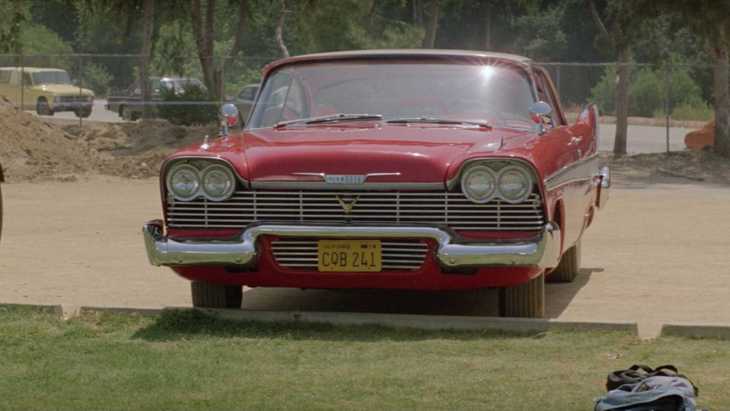
138. Christine (1958 Plymouth Fury) | Christine (1983)
While I hate the fact that The Thing flopped at the box office, if it didn’t, we never would’ve gotten Carpenter’s take on Christine. He was originally attached to do Firestarter and while I have no doubt in my mind he would’ve crushed the assignment, it’s a story anyone could do a decent job of adapting. Correction, any decent director *cough* Keith Thomas *cough*. But the failure of The Thing actually lost Carpenter that job and another job, so Christine is one of his only work-for-hire gigs. Which is probably why he directs the fuck out of it. He was in desperate need of a hit and he showed up with something to prove. His work in this film is so good, he convinces you that the car at the center of things, is actually alive.
He imbues Christine with so much personality, it transcends the typical killer car to become a fully fleshed out character. The film needed a director as good as Carpenter to make Christine come alive because she’s no ordinary car. Though it appears to be a classic, beautifully restored 1958 Plymouth Fury, it harbors a malevolent spirit, capable of restoring itself to pristine condition after sustaining damage. The car exudes a sinister influence over its new owner, Arnie Cunningham (Keith Gordon), transforming him from a shy, awkward teenager into someone darker and more confident—but also more dangerous. Christine develops a near-sentient attachment to Arnie, almost like a jealous lover. Anyone who stands between the car and Arnie, or anyone who threatens the car in any way, becomes a target of Christine’s wrath. The car’s capacity for violence is beyond reason, able to crush, chase, and kill with methodical precision, often appearing to take pleasure in its destruction.
Her ability to regenerate, becoming shiny and new after suffering any damage, emphasizes her supernatural nature. This regenerative quality also aligns with Christine’s thematic role as something seductive and dangerous, luring people in with beauty but hiding an evil core. Christine is one of the most iconic killer cars in film history, and the 1958 Plymouth Fury has since become synonymous with evil vehicles in pop culture. Much like Carpenter’s other work (Halloween being a notable example), Christine combines a chilling, unstoppable force with a creeping sense of dread. The car’s sleek and nostalgic appearance makes its violent actions even more shocking, creating an enduring sense of terror.

137. Renfield (Various) | Dracula (Franchise)
Renfield, a character that appears in various adaptations of Dracula across literature and film, is a fascinating figure in vampire lore. Traditionally depicted as Dracula’s loyal but disturbed servant, Renfield plays a significant role as both a victim and a pawn in the vampire’s schemes. His character has evolved through numerous portrayals, with his motivations and psychological state often being a point of focus. While technically not the first portrayal of the character, Dwight Frye set the gold standard in Dracula (1931).
His performance is iconic, establishing Renfield as a wild-eyed, twitchy figure who vacillates between servility and desperate attempts to break free of Dracula’s control. In Bram Stoker’s Dracula (1992), Renfield (Tom Waits) is presented as a more bizarre and eccentric character. His madness is central to his persona, with Waits emphasizing the character’s mental instability and grotesque habits while still showcasing Renfield’s tragic dimensions. In Hammer Horror films, Renfield has been portrayed by actors like Klaus Kinski (Count Dracula, 1970) and Jack Shepherd (Countess Dracula, 1971), offering variations on the classic portrayal, often focusing on his relationship with Dracula and his obsessive behavior.
The 2023 film Renfield takes a fresh, modern spin on the character, reimagining his story and dynamic with Dracula. In this version, Renfield (Nicholas Hoult) is depicted as an embattled servant who seeks to break free from his toxic, codependent relationship with Count Dracula (Nicolas Cage). Every iteration brings their own unique spin on madness, with no interpretation being bad. He’s a rare character where every version is equally great.

136. Santanico Pandemonium (Salma Hayek) | From Dusk Till Dawn (1996)
Santanico Pandemonium is a mix of sensuality, danger, and authority. As the queen of the vampires, she combines an irresistible, captivating charm with raw, terrifying power. Her transformation from a sultry, mesmerizing dancer into a vicious, bloodthirsty creature makes her the embodiment of danger hidden beneath beauty. Santanico is the perfect mix of seductive and scary, flipping from sultry to savage in the blink of an eye. In that unforgettable dance scene, she doesn’t just steal the show—she owns it, commanding every gaze like she’s got the whole room under her spell. Sure, she’s a vampire, but it’s her irresistible charisma and take-no-prisoners attitude that really make her a standout. She’s the kind of character who’s both dangerously fun and unpredictably fierce, which is why she leaves such a lasting impression.
—Ricky Ratt

135. Rudy (Ryan Lambert) | The Monster Squad (1987)
I believe there was no better time to be a kid than the 1980’s. Hollywood was an imagination machine, kicking out nothing but backyard fantasies you’d recreate with your friends. You could all be a bunch of Rambos trying to save POWs, or make homemade light sabers out of broom sticks covered in pool noodles or strap your mom’s vacuum to your back to go bust some ghosts.
But out of all the films that came out that decade, the film no one ever recreated with their friends was the Monster Squad. Not because it wasn’t cool (it was) or because it was a flop (it was), but because every kid who saw that film didn’t want to be in the Monster Squad, they wanted to be Rudy.
He wore a leather jacket and shades, smoked cigarettes and kills damn near half of the monsters in the film. He was the coolest motherfucker we had ever seen and that’s the real reason why we never played Monster Squad. Because we knew, deep down inside, we weren’t cool enough to even pretend to be him.

134. Barbara (Judith O’Dea) | Night of the Living Dead (1968)
O’Dea’s Barbara has gotten shorter shrift, in part because her character fits into a pretty well defined film stereotype – that of the “woman in distress.” That she also essentially fades into the background once the Coopers and Tom and Judy appear doesn’t help, but I’ve always liked the character. Yes, she essentially has a nervous breakdown once the reality of her situation hits, but then she manages to pick herself up and help Ben try and keep out the hordes. And before then she keeps moving, keeps fighting, it’s only in a moment of relative safety that her fear overwhelms her – something I think I can identify with.
—Bob Cram

133. La Femme (Béatrice Dalle) | Inside (2007)
La Femme (real name never revealed) is a mysterious and relentless figure who invades the home of Sarah (Alysson Paradis), a pregnant woman who is mourning the loss of her husband. La Femme’s motivation, revealed through the film’s brutal and harrowing events, is tied to her tragic backstory involving the loss of her own unborn child. Dalle’s character is hell-bent on taking Sarah’s baby by any means necessary, and the entire film is a claustrophobic, violent standoff between the two women. Dalle’s performance is unsettling and intense. She brings a cold, almost animalistic quality to the character, often silent but with an unspoken rage simmering beneath the surface.
Her presence alone creates a sense of dread, as she appears utterly single-minded in her mission. Her physicality in the role—whether it’s her eerie stillness or sudden bursts of violence—adds to the relentless tension that builds throughout the movie. Her performance contrasts starkly with her earlier roles, like in Betty Blue, where she played passionate, emotional characters. Here, she embodies something darker, a woman who is beyond reason and has been warped by grief into a terrifying force. Her performance is one of the most chilling aspects of the film, helping to establish Inside as one of the most notorious entries in the “New French Extremity” movement.

132. Regina “Reggie” Belmont (Catherine Mary Stewart) and Samantha “Sam” Belmont (Kelli Maroney) | Night of the Comet (1984)
When Joss Whedon was creating what would eventually become his most enduring character: Buffy the Vampire Slayer, his major inspiration was the happy-go-lucky cheerleader Samantha Belmont from the post-apocalyptic zombie flick Night of the Comet. Along with her arcade-obsessed older sister Regina, the Belmont sisters might be the most likable and capable protagonists of any zombie film since Peter (Ken Foree) and Roger (Scott H. Reiniger) from Dawn of the Dead.
Reggie is the older sister, portrayed as tough, resourceful, and self-reliant. She works at a movie theater and has a love for arcade games, which ties into her independent nature. Her survival instincts kick in quickly after the comet disaster, and she becomes a natural leader in the post-apocalyptic environment. Sam, on the other hand, is the younger sister, more playful and carefree compared to Reggie. She is a cheerleader, which aligns with her bubbly and energetic personality. Despite her more lighthearted and somewhat naive demeanor, Sam proves to be just as tough and resourceful as her sister when it comes to survival. Her character offers comedic relief but is also surprisingly capable of dealing with the chaos surrounding her. Together they make an unstoppable and unforgettable team. It’s a shame we didn’t get sequels with this pair, they’re delightful.

131. Elvis (Bruce Campbell) | Bubba Ho-Tep (2002)
Elvis never died. Seriously. He switched with an Elvis impersonator named Sebastian Haff back in the 1970s, after getting tired of the fame, the drugs, and the emptiness of life. Now he’s living in a retirement home in East Texas, contemplating age, illness, impotence and generally facing the end of life with apathy and a pecker with a growth on it.
A good chunk of the early part of Bubba Ho-Tep is spent with Elvis in despair. He can barely bother to pay attention to the goings on in his room. Bruce Campbell is excellent as the King in the winter of his life, able to pull off pathetic and charismatic at the same time. You could almost believe he was Elvis.
I love Ozzie Davis and Bruce Campbell together, they’re like an old comedy duo. Elvis’ struggle to find a reason to go on has some decent dramatic heft. There’s also some super-dodgy special effects (the scarab looks like a windup toy) and a middle act as saggy as ‘Fat Elvis.’ For me, though, Bubba Ho-Tep manages to entertain in spite of its shortcomings, and Elvis is a big part of that.
—Bob Cram

130. Mrs. Vorhees (Betsy Palmer) | Friday the 13th (1980)
Pamela Voorhees is the quintessential “don’t mess with my kid” mom taken to terrifying extremes. On the surface, she seems like a sweet, ordinary woman, the kind you’d see baking cookies or volunteering at a bake sale. But once you dig deeper, you realize she’s anything but ordinary. She’s driven by a fierce, all-consuming need to avenge her son Jason’s tragic death. Dressed in her cozy sweater and speaking in that calm, motherly tone, she expertly hides the fact that she’s a relentless, cold-blooded killer. Her fury is fueled by grief, making her unpredictable and far more dangerous than she first appears.
As she lurks around Camp Crystal Lake, there’s an eerie, twisted sense of maternal protection in everything she does. Each victim is just one more step in her mission to make everyone pay for what happened to Jason. She’s not just your typical slasher villain—her motivations make her even more unsettling. In a genre filled with masked killers, Mrs. Voorhees stands out by revealing that sometimes the scariest thing isn’t a masked monster, but a mother scorned.
—Ricky Ratt

129. The Freelings (JoBeth Williams, Craig T. Nelson, and Oliver Robins) | Poltergeist (1982)
One of the main reasons I believe a lot of people think Spielberg secretly directed Poltergeist is the handling of The Freelings. Tobe Hooper is a fantastic filmmaker but he’s never directed actors as well as he does in this film. The family—composed of Diane (JoBeth Williams), Steven (Craig T. Nelson), and their children, including Robbie (Oliver Robins)—are an ordinary suburban family suddenly thrust into a terrifying ordeal when their home becomes haunted by malevolent spirits.
There’s also Dana Freeling (Dominique Dunne), who I’m excluding because her character immediately peaces out the second there’s spooky shit (a detail that I love) and Carol Anne Freeling (Heather O’Rourke) who will be higher up on the list. Diane is the matriarch of the Freeling family and one of the film’s most central characters. She is a loving, strong, and protective mother who initially seems excited about the seemingly benign paranormal activity in the house. However, when the haunting takes a darker turn and her youngest daughter, Carol Anne, is abducted by the supernatural forces, Diane becomes a fiercely determined mother.
Steven, the father, is a real estate agent who works for the company that developed their home and the surrounding neighborhood. He is initially skeptical of the strange occurrences in their house but gradually becomes more involved as the supernatural forces grow stronger. As a family man, Steven is practical and protective, doing everything he can to uncover the cause of the haunting. The two of them are surprisingly hip for a married couple in the ’80s.They smoke pot in bed together and you can just tell they be fucking.
There’s also Robbie, the middle child in the Freeling family and serves as a focal point for much of the film’s tension and fear. He is the first to express unease about their home, showing an early sensitivity to the supernatural occurrences, particularly his fear of a sinister-looking toy clown and the eerie tree outside his bedroom.
The Freeling family represents an idealized, loving American suburban family, which is part of what makes their encounter with the supernatural so impactful. The film contrasts their ordinary, happy lives with the intrusion of terrifying otherworldly forces. Diane and Steven’s deep love for their children, especially their determination to save Carol Anne, is the emotional core of the story. They are portrayed as a close-knit unit, which makes the horror they face all the more effective.

128. Esther (Isabelle Fuhrman) | Orphan (Franchise)
At first glance, Esther appears to be an innocent, sweet, and intelligent young girl, playing into the audience’s expectations of her being vulnerable. However, as the movie progresses, it becomes clear that there is something disturbingly off about her. Her ability to present herself as harmless while secretly being manipulative and violent creates a deeply unsettling atmosphere.
What makes Esther especially terrifying is the twist that she is not a child at all, but a dangerous adult with a rare condition that makes her look young. This revelation sheds a new light on her actions and amplifies the horror, as she becomes a calculated predator who has fooled everyone around her. Her violent tendencies, combined with her cunning intelligence and ability to exploit the trust of those who take her in, make her a uniquely chilling antagonist. Esther’s ability to blend into her environment, masking her true nature, makes her a powerful and memorable figure.
—Ricky Ratt

127. Reggie (Reggie Bannister) | Phantasm (Franchise)
There aren’t many examples of a supporting character becoming the lead of the franchise. I previously discussed Burt Gummer as being one of the best examples but as good as he is, I think the best is Reggie Bannister. The story was clearly supposed to follow Mike but overtime, it shifted to Reggie and I think it’s all the better for it. In the original film, Reggie is introduced as a laid-back, guitar-playing ice cream man and a friend to the main protagonist, Mike Pearson. Initially, Reggie is more of a side character, providing some levity to the strange and eerie world surrounding the Morningside Cemetery.
However, as the film progresses, he becomes more entangled in the battle against the Tall Man. By the second film, Reggie takes on a much more prominent role as a full-fledged action hero. Armed with his iconic four-barreled shotgun, Reggie embarks on a road-trip-style adventure with Mike, hunting the Tall Man and his minions. His character is defined by his unwavering loyalty to his friends, his sense of humor, and his gritty determination to stop the Tall Man’s apocalyptic plans, despite being an everyman. He evolves from a comedic sidekick into the heart and soul of the franchise.

126. Wendy (Shelley Duvall) | The Shining (1980)
Some fans of the book outright hate Kubrick’s version of Wendy Torrance. He made her far more emotionally unstable and manic but that interpretation fits the tone he was going for. He wanted her to be a shell of a woman who was clearly broken before she ever steps foot inside the hotel. She’s a victim of Jack Torrance (Jack Nicholson) and the Overlook Hotel who then becomes a symbol of resilience. Wendy is a kind, soft-spoken, and somewhat timid woman, who accompanies her husband and young son Danny to the isolated Overlook Hotel, where Jack takes a job as the winter caretaker.
Throughout the early part of the film, Wendy appears optimistic, determined to support her husband’s efforts to write and hoping that the isolation might be good for their family. Her character is maternal and protective, especially toward her son, who has psychic abilities (“the shining”). As the events of the film progress and Jack begins to descend into madness, Wendy’s role shifts from being a passive figure to one of survival and protection. She starts to realize that something is very wrong with both Jack and the hotel itself. Shelley Duvall portrays Wendy as increasingly desperate and terrified as the supernatural horrors of the Overlook emerge and Jack becomes violent. Her fear is palpable, especially in the iconic scene where she confronts Jack on the staircase, wielding a baseball bat to defend herself and Danny.
Her performance is particularly notable for its emotional rawness, as she endured extreme stress during filming. Kubrick was infamous for putting her through grueling, repetitive takes to heighten her sense of anxiety and exhaustion, which is reflected in her portrayal. This approach, though controversial, resulted in a deeply visceral and authentic performance that has since been recognized as one of the standout elements of the film. The Razzies actually nominated her for worst actress of the year, a colossal blunder that invalidated anything they would ever do from that point forward, because not only is it not one of the worst performances of that year, but it’s one of the best of all time.
175-151 | 125-101
What do you think of the list so far? Which characters do you hope will make the cut?
The official ScreenAge Newsletter has arrived! Subscribe to receive a semi-regular round-up of all our exclusive content, including reviews, editorials, Top 100 lists, and more! C'mon, we know you want to venture further into the Wasteland with us!
