
Since birth, we’ve been indoctrinated with a love of horror, whether we knew it or not. The first game your mother would play with you involved her hiding behind her hands and then shouting, “Boo!” We would get taught folk tales that involved a witch wanting to eat children or a wolf wearing the skin of an elderly woman. Some of us were warned of the Krampus, who’d kidnap misbehaving little boys and girls. We’d play Bloody Mary and watch old Disney films. You know, the scary ones. It was a lifetime of preparation for horror. Because deep down, we all have an innate desire to be frightened. We crave it and these characters scare us better than any others. Since this list encompasses the entire history of horror, every genre (and subgenre) is represented. Everything from creature features to kinder trauma, action movies to horror comedies are eligible. I combined characters if they worked as a duo or a group and I excluded animals (save for one) unless they were supernaturally possessed or if they had an internal monologue so that we could understand their motivations. I also only included characters from thrillers if they targeted children. This list is a celebration of horror and the icons that help us lose sleep at night.
These are the 500 Greatest Horror Characters of All Time.

375. Delbert McClintock (John Goodman) | Arachnophobia (1990)
I used to be arachnophobic, so this movie hit me harder than it probably did other people. I remember pulling my feet up onto my chair in the theater, so spiders wouldn’t get me. As seriously as I took the film – which was way too much – that all went out the window when Delbert arrived. Arachnophobia always leaned into the humor element, but Delbert shoved things into true, overt goofiness. And man, did I love him for it. He’s overconfident, not that great at his job, and full of useless and often erroneous pest information. Goodman plays him bigger than life, and I honestly think the movie would be even better if more of the actors had followed his lead. The adventures of Delbert continued in the Arachnophobia video game. Yeah, I didn’t realize there was one either, but you can find it online.
-Bob Cram

374. Deborah Logan (Jill Larson) | The Taking of Deborah Logan (2014)
What begins as a heartbreaking medical documentary about one woman’s descent into Alzheimer’s disease degenerates into a maddening portrayal of mental illness at its most frightening. As unexplained events begin to plague the family and crew, you begin to question whether this is merely the effects of dementia or something far more sinister. Recent films like The Visit and Amour show that there’s nothing more terrifying than the slow deterioration of the mind and if The Taking of Deborah Logan never went supernatural, it would still be scary as hell. The first act is so painfully realistic, it’s hard to look at sometimes. In fact, the film could’ve ditched the horror completely and been a really great character drama. But thankfully, they decided to make a film in which a creepy old lady devours a little girl whole.

373. Jesus Gris (Federico Luppi) | Cronos (1992)
Jesus Gris is an elderly antiques dealer who comes across a mysterious, ancient device—the Cronos—a mechanical scarab that grants eternal life, but with a terrible cost. Jesus is initially drawn to the Cronos out of curiosity, but its promise of youth and vitality proves too tempting to resist. The device transforms him, both physically and emotionally, as it slowly turns him into a vampiric creature, craving blood. Luppi’s performance captures the internal struggle of Gris, who finds himself torn between his humanity and the horrifying consequences of immortality. As he grapples with the transformations and the increasing danger from the sinister figures who seek the Cronos for themselves, Jesus’s love for his granddaughter Aurora remains his emotional anchor. This relationship adds depth to his character, portraying him not just as a victim of the device, but as a man desperately trying to protect what remains of his humanity. Leave it to Del Toro to reinvent the vampire story in the weirdest and most heartfelt way possibly.

372. William G. Dobbs (Jack Albertson) | Dead & Buried (1981)
William G. Dobbs is the town’s eccentric and enigmatic coroner and mortician. On the surface, Dobbs seems like a quirky, small-town figure, someone dedicated to his work with an obsessive flair for making the dead “look alive” through his embalming techniques. His fascination with the dead takes on a deeper, more sinister meaning as the film progresses. Dobbs is revealed to be the mastermind behind the town’s eerie happenings, where the dead mysteriously return to life. His motivations are rooted in a twisted desire to control life and death, viewing his reanimation work as an art form. Albertson’s portrayal of Dobbs is chilling, as he delivers his lines with a calm, almost fatherly demeanor, masking the deeply unsettling nature of his actions. As the film’s secrets unravel, Dobbs’ calm façade gives way to a more disturbing presence, highlighting the character’s god-complex and his moral ambiguity. His philosophical musings about life, death, and immortality add a layer of depth to his character, making him a fascinating antagonist. If all you Jack Albertson from is Grandpa Joe from Willy Wonka & the Chocolate Factory, prepare to have that image of him destroyed forever.

371. Koichi Shikishima (Ryunosuke Kamiki) | Godzilla Minus One (2023)
A failed Kamikaze pilot, Shikishima (Ryunosuke Kamiki) survives World War II AND Godzilla (albeit a smaller version), mostly by being afraid to do anything. Shikishima returns home to find Tokyo in ruins, and his parents dead. There’s a moment, standing in the shattered pieces of what used to be his life, traumatized by his own loss and battered by the judgement of a neighbor who also lost everything, where you can see Shikishima thinking, “what did I even survive the war FOR?” It’s not hard to extrapolate this to Japan itself after World War II – all that death and destruction, and for what?
Life goes on, though, even in the ruins, and soon Shikishima finds himself living with, and caring for, Noriko Ōishi (Minami Hamabe) – a young woman who also lost everything in the war. She brings with her an orphaned girl, Akiko (Sae Nagatani). As time passes, the two adults find work, Noriko in an office in Ginza, Shikishima on a minesweeper boat – the wooden hull making it ideal for taking out magnetic mines left over from the war. It’s a hard life, and Shikishima seems unable to move on from the war enough to see how much Noriko cares for him, but things are getting better.
And then Godzilla shows up.
Ryunosuke makes you believe in all the heartbreak Shikishima suffers. The hope and the fear and the self-hatred. He represents a spirit of Japan itself post-war, full of rage, doubt and humiliation and fear that everything that they survived wasn’t enough to pay for everything that they did – or didn’t do. It’s a Godzilla movie, and man do I love the big G in this, but Shikishima is what makes the film more than just another kaiju beat-em-up.
-Bob Cram

370. Grant Grant (Michael Rooker) | Slither (2006)
Despite having numerous iconic roles over a 30+ year career, Michael Rooker languished in near obscurity till James Gunn started using him. Horror fans knew him from Henry: Portrait of a Serial Killer and comedy fans knew him from Mallrats but to everyone else, he was “that guy from that thing.” After GOTG, he became a household name but years before that, he was the giant, goopy worm man in Slither. In the film, he plays Grant Grant, a wealthy resident of the small town of Wheelsy. His character undergoes a disturbing transformation after being infected by a parasitic alien organism. Initially a normal, albeit unpleasant, individual, Grant becomes the film’s main antagonist as the parasite turns him into a grotesque creature with an insatiable desire to spread its spawn and consume other life forms. As Grant mutates, he retains some memories of his past life, including his affection for his wife, Starla (Elizabeth Banks). This adds a tragic layer to his character, as his love for Starla is juxtaposed against his monstrous appearance and horrifying actions. Rooker’s performance brings depth to what could have been a one-note villain, giving Grant a certain pathos even as he becomes a horrific threat to the town.

369. Jessie (Carla Gugino) | Gerald’s Game (2017)
For years, Gerald’s Game seemed to be the one Stephen King book that was unfilmable. Some of his work will never see the big screen without having massive changes made to the source material (The Running Man ends with the main character crashing a plane into a tower) but that’s just a matter of editing out controversial scenes. Gerald’s Game is a story no one seemed to be able to crack. I guess they were waiting for an actress as talented as Carla Gugino to come around to make it work. In the film, she plays Jessie Burlingame, a woman trapped in a life-threatening situation after a weekend getaway with her husband, Gerald (Bruce Greenwood), goes horribly wrong. She is handcuffed to a bed during a game of sexual roleplay and almost immediately after, her husband dies of a heart attack leaving her locked to the bed.
For the rest of the film, she’s stuck in that bed, which is why no director wanted to touch this story. Jessie’s character arc is one of empowerment and survival. As she remains confined to the bed in a remote lake house, she battles hallucinations, suppressed trauma, and her own mind to find a way to escape. Gugino’s performance is raw, emotional, and compelling, as she conveys Jessie’s mental struggle with the ghosts of her past—particularly the abuse she suffered as a child—and her growing desperation to survive. The role demands both physical endurance and emotional vulnerability, and Gugino expertly balances the two, portraying Jessie’s transformation from a woman trapped by both physical and psychological restraints into someone who confronts her past and fights for her future.

368. Mary Henry (Candace Hilligoss) | Carnival of Souls (1962)
This no budget film made by a first time director starring an actress with zero experience went on to become one of the most important and influential films ever made. Night of the Living Dead wouldn’t exist without this. Final Destination wouldn’t exist without this. Silent Hill probably wouldn’t exist if not for this. Its fingerprints are on so many things, it is unreal. After surviving a car accident, Mary Henry finds herself increasingly disconnected from the world around her. She moves to a new town, haunted by strange visions of ghostly figures, particularly a mysterious “man” (played by the director himself), and an eerie, abandoned pavilion that seems to beckon her.
After the accident, she appears emotionally detached and aloof, as if she’s lost her connection to life itself. Hilligoss delivers a nuanced performance, capturing Mary’s increasing alienation from both her surroundings and the people she encounters. As the film progresses, her sense of unreality deepens, and it becomes clear that Mary is caught between the world of the living and the dead. Her journey is one of psychological and spiritual displacement, and Hilligoss’ portrayal brings a haunting vulnerability to the character. Mary’s growing unease, her attempts to rationalize the strange occurrences, and her ultimate fate make Carnival of Souls an eerie meditation on life, death, and the liminal space in between.

367. The Nun/Valak (Bonnie Aarons) | The Conjuring Universe
James Wan really wanted to turn The Conjuring Universe into a massive franchise, with each film being a springboard to introduce a standalone monster movie. In addition to Annabelle and The Nun, there were plans to make a movie out of The Crooked Man from The Conjuring 2 and any one of the items revealed in Annabelle Comes Home. I personally would’ve loved to have seen a Crooked Man stand-alone movie and would trade all the spin-offs *and* the proposed spin-offs we got to get just one of those, but if I can’t have that, getting more of an evil ghost nun is a pretty great consolation prize. Some horror purists write The Nun off as the horror equivalent of the soup of the day and while I agree that I don’t think she’ll have any lasting appeal, I do acknowledge that she’s a hit with a very specific audience. They love Valak and while I don’t like either of her films, I see the appeal. If there was a scary ghost scale, evil nun is smack dab in the middle of creepy little kid and hooded figure in the distance.

366. Kinderman (George C. Scott) | The Exorcist III (1990)
I always liked Lee J. Cobb’s turn as Lt. Kinderman in the first Exorcist film, but he’s got little to do there, whereas George C. Scott is pretty much the central character of Legion (a subtitle for Exorcist III). Kinderman is a no-nonsense cop who slowly begins to believe that his murder suspect really is possessed. Of course, the suspect is his old friend, Father Karras, who is supposedly dead. That might have been a giveaway. Scott is magnetic in this, always anchoring every scene with wit, charisma, and gravitas. Director (and writer) William Peter Blatty lets Scott sell us on the horror, lets his face and his voice tell us just how awful things are, and Scott is more than up to the task. Legion is an underappreciated horror gem and as a result, too many people haven’t seen George C. Scott give one of his most nuanced and affecting performances. Give it a shot – just pretend the second movie doesn’t exist.
-Bob Cram

365. Sandie (Anya Taylor-Joy & Diana Rigg) | Last Night in Soho (2021)
If there was one theme running through most of the films of 2021, it would be the reexamination of nostalgia. So many films from No Time to Die to Matrix Resurrections to No Way Home to even Licorice Pizza used nostalgia in wildly different ways. Some embraced the past without annoyingly winking at the audience, while others, like Last Night in Soho, treated it as the plague it is. The main character of this film is obsessed with the ’60s and for unclear plot reasons (it’s a thinly veiled giallo, just go with it), she inhabits the body of a young woman from that time named Sandie who’s leading a terrible life. She’s being passed around from producer to producer and is eventually pimped out by her boyfriend. All she wants to do is be a singer and the industry is hell-bent on stripping away her dream and her clothes.
Although it only takes up a fraction of the runtime, her story is the meat of the film. It’s far and away the most compelling thing about the movie and introduces a concept I haven’t seen actualized on screen in quite some time, which is the idea that the past is literally a ghost that haunts us. When the main character leaves her body and returns to the present day, she’s still haunted by the figures she saw in the past but since they’re not directly tied to her, they’re a stand in for nostalgia. The past itself is the true villain of the movie or rather, her idealized version of it. We all look at previous decades with rose tinted glasses but the true is, we can never truly know how ugly a certain period of time is unless we lived through it. Sandie lived through it, came out the otherside scarred and refuses to be a victim any longer. She’s both a victim and the main antagonist, a rare feat for any horror character.
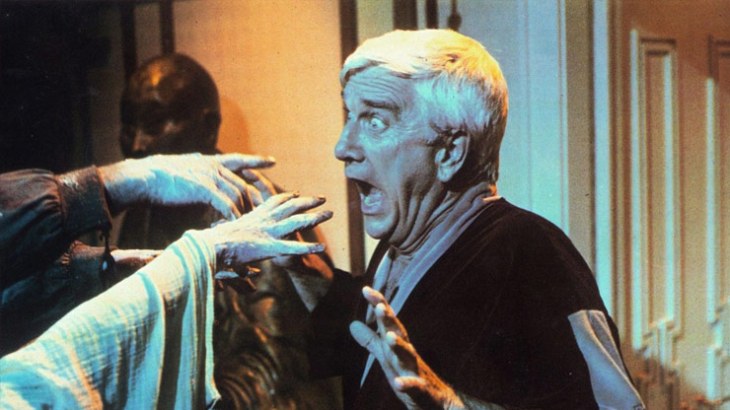
364. Richard Vickers (Leslie Nielsen) | Creepshow (1982)
I’ve always thought Leslie Nielsen had a very punchable face, and he and never has he been more punchable than as wealthy businessman and super-asshole Richard Vickers in the “Something to Tide You Over” segment of Creepshow. It’s not just his smarminess, though that’s off the charts, but it’s how laid back he is about all the murder – burying his wife and her lover (Ted Dansen – also punchable) up to their necks in sand and waiting for the tide to drown them. Creepshow takes its inspiration from the old EC horror comics and there is not much in the way of subtlety to the stories. Vickers is a truly despicable man, with no redeeming qualities, so it feels every so good when he finally gets his comeuppance. I just wish someone had punched him, in addition to burying him in the sand.
-Bob Cram

363. Annabelle | The Conjuring Universe
Annabelle is the ultimate nightmare fuel, a seemingly innocent doll that’s anything but sweet. With her porcelain face and vintage charm, she lures you in, but don’t let that pretty exterior fool you—this doll is a god damn vessel of pure evil. Annabelle is not just a doll; she’s a malevolent force that thrives on chaos, leaving a bloody trail of horror behind her. The way she shifts positions or suddenly appears in the corner of a room will make your heart race and your skin crawl. You’ll find yourself jumping at every little noise, convinced that she’s watching you with those lifeless eyes. The chilling thought that she could be lurking just out of sight solidifies her as a true horror icon. If you think you can handle her, just remember: once she’s in your life, she might never let go, turning every moment into a pulse-pounding, heart-stopping game of terror that’ll leave you sleeping with one eye open.
—Ricky Ratt

362. Bol (Sope Dirisu) and Rial (Wunmi Mosaku) | His House (2020)
There’s an old stand up bit about the difference between white people and black people in horror movies, specifically haunted house movies. The second a creepy house says “get out”, black people listen. It’s a funny joke that reveals a major deficiency in most films within that sub-genre, which is “why are these people still in this house?” Some movies try to subvert this by explaining that it’s the people within the house, not the house itself, that’s haunted. His House does something similar but the way in which it addresses that question is brilliant. The couple at the center of the film can’t leave their house due simply to the fact that they’re refugees assigned a shitty duplex within England’s housing complex. If they complain about ghosts or try to leave, they’ll immediately be deported. They’ve left hell for purgatory and they didn’t go alone.
If that’s all this film had going for it, I still would’ve liked it but what makes that set up work even better, is how they both deal with the situation. They both see the ghosts; there’s no question that they’re being haunted but instead of dealing with it, the husband actively chooses to ignore it just so that he can more easily blend in with society. He wants to purge himself of the past in order to adjust to his new life but as the old saying goes, “the past is a ghost that haunts you, from the moment it exists, to the moment you don’t.”

361. Blade (Wesley Snipes) | Blade (Franchise)
Blade is famously a “Daywalker”, a half-vampire hybrid who can walk in the sun without getting hurt but he should also be called a “Listwalker” because he’s a rare example of a character that can walk between radically different lists. He’s the only example I can think of that could appear on both a greatest comic book movie characters list and a greatest horror characters list. If your only exposure to him is his extended cameo in Deadpool and Wolverine, you have no idea his horror origins. In the first scene of his debut film, he massacres a fuck ton of vampires at an underground blood rave and in the sequel, he actually leads a group of badass suckheads (his name for vampires) against another group of mutated vampires. He’s cooler than Van Hellsing, more badass than Buffy and has better one liners than Ash. He’s the ultimate vampire killing motherfucker and is one of the best examples of perfect casting.
His line in Deadpool and Wolverine may have been a subtle jab at the fact that he’s been replaced in the MCU but it’s also not wrong, there’s only one Blade and it’s Wesley Snipes. He brings a unique combination of stoic intensity, martial arts prowess, and swagger to Blade. His performance is understated but commanding, balancing the character’s internal struggle with his external confidence as a relentless hunter. Blade’s dry sense of humor and no-nonsense attitude make him a compelling anti-hero who exists in the morally grey area between the human and vampire worlds. Snipes’ physicality is central to the role, with his impressive fight choreography elevating the action scenes to some of the most memorable in comic book cinema at the time.

360. Kopfrkingl (Rudolf Hrusínský) | The Cremator (1969)
Set in Czechoslovakia during the prelude to World War II, Kopfrkingl is a seemingly mild-mannered and devout crematorium operator who gradually descends into madness, influenced by twisted ideological beliefs and the encroaching fascist regime. Kopfrkingl is a meticulous and soft-spoken man who takes pride in his work, viewing cremation as a spiritual release that liberates the soul from suffering. His obsession with death, combined with his increasing fascination with Nazi ideas about racial purity and “cleansing,” leads him down a path of horrific moral decay.
Hrušínský’s performance is masterful, as he shifts from portraying Kopfrkingl as an eccentric but gentle man to embodying a monstrous figure who justifies murder as an act of mercy. His calm demeanor and unwavering belief in his own righteousness make his character even more terrifying. The more Kopfrkingl embraces the dehumanizing ideologies around him, the more detached he becomes from reality, seeing himself as an agent of divine justice. His character is a haunting representation of how easily a banal, seemingly ordinary person can be seduced by dangerous ideologies and commit unspeakable acts in their name.

359. Lena (Natalie Portman) | Annihilation (2018)
When I think about Annihilation it’s not the characters I think of first. No, it’s that damn bear with the human scream coming out its throat. Then it’s the weird landscape. Then it’s the soldier who has become a fungal bloom. Then it’s the silvery doppelganger in the lighthouse. The fact of the matter is, I forgot Oscar Isaac was even in the film, that’s how little the characters impacted me. Except Lena. Except Natalie Portman. Lena is honestly a bit of a cipher, and you’re never clear on what it is she’s thinking, what her motivations are– other than a determination to find out what happened to her husband, the only survivor of a previous expedition into the “Shimmer.” One of the characters tells her Lena wants to “fight” the Shimmer – the result of an alien impact on Earth – and that’s as good a description of her motivations as any. As a biologist she wants to understand how the Shimmer is affecting the world, her husband, and herself – but she wants to remain her own person. Everyone else in her expedition succumbs to the transformative nature of the alien force (it’s described as “refracting” reality, including DNA), but Lena manages to maintain her essential self. Yes, she ends up changed, but she accomplishes her goals. Finding out what happened to her husband. (Not good.) And managing to maintain her identity – even if she has been changed by both the experience and the Shimmer.
-Bob Cram

358. Elizabeth Báthory (Delphine Seyrig) | Daughters of Darkness (1971)
Sexier than a Rollin film and as stylish as a Franco film, Daughters of Darkness is the gold standard when it comes to lesbian vampire films. While on vacation, a newlywed couple (Danielle Ouimet and John Karlen) cross paths with a mysterious, strikingly beautiful countess (Delphine Seyrig) and her equally gorgeous aide (Andrea Rau). It’s a standard set up for these types of movies and while it doesn’t deviate much from the Carmilla formula it’s clearly lifting from, you’ll be too transfixed to care. The reason you’ll overlook any of the films flaws is due to Seyrig. Her vampire countess is as alluring as she is dangerous. Channeling Marlene Dietrich, Seyrig is firing on all cylinders as the legendary Elizabeth Bathory. She’s white hot liquid sex and her aid might be even hotter. No man or woman alive can turn down their advances, which is their ultimate weapon.

357. Clear Rivers (Ali Larter) | Final Destination (Franchise)
The only character to make it to a Final Destination sequel, Clear Rivers (hippy parents, I’m guessing?) manages to cheat death several times over the course of the first two films. She starts out as an outsider in school who forms a connection with Alex after his vision saves her from dying in a plane explosion. Though she and Alex survived the first film, by the events of Part II Alex has died, and Clear has committed herself to an institution to try and avoid situations where Death could get at her. Eventually, she realizes that she has to figure out a way to satisfy Death, or she – and other survivors – will always just be waiting to die. Capable and sympathetic, Clear is a good character – but Death is always waiting.
-Bob Cram

356. Lee (Timothée Chalamet) and Maren (Taylor Russell) | Bones and All (2022)
Lee, and Maren are two outcast young adults with a shared dark secret: both are “eaters,” people with a compulsion for cannibalism. After being abandoned by her father due to her cannibalistic urges, Maren embarks on a journey to find her estranged mother and understand her condition. Russell’s performance captures Maren’s loneliness and her struggle to accept who she is. Her portrayal is filled with sensitivity, as she grapples with both guilt and a desperate need for connection in a world that will never accept her. Lee is a drifter who has learned to survive on the margins of society by indulging his cannibalistic urges in secret. His character is both charming and emotionally wounded, and Chalamet brings a raw, magnetic energy to the role.
Lee’s relationship with Maren becomes central to the film, as they bond over their shared affliction while navigating the moral and emotional consequences of their condition. The chemistry between Chalamet and Russell is palpable, grounding the film’s horror elements in a deeply human story about love, loneliness, and the desire to belong. Together, Lee and Maren’s journey across the American Midwest is both tender and terrifying, as they struggle to reconcile their feelings for each other with the horrific reality of their lives. Their relationship becomes a tragic exploration of love on the fringes of society, where their bond is both their salvation and their curse.

355. Dani (Florence Pugh) | Midsommar (2019)
Dani Ardor is a young woman grappling with intense grief and trauma after a horrific family tragedy who decides to accompany her emotionally distant boyfriend, Christian (Jack Reynor), and his friends to a remote Swedish village for a once-in-a-lifetime midsummer festival that slowly reveals its sinister, pagan undertones. Dani’s emotional journey is central to the film’s unsettling exploration of loss, isolation, and rebirth. At the outset, she is depicted as fragile and dependent, struggling to process her grief while feeling increasingly alienated from Christian, whose ambivalence and lack of support amplify her vulnerability. Pugh masterfully conveys Dani’s deep-seated anxiety and emotional fragility, making her pain palpable in every scene. As the rituals of the village grow more disturbing, Dani finds herself drawn into the cult-like community, which offers her the emotional support and sense of belonging that she lacks in her relationship. Ari Aster designed the film to feel like a love story for her and a horror for her boyfriend and as the film progresses, that becomes apparent. She becomes seduced by their rituals and lifestyle, while his journey becomes increasingly more horrifying and hostile. It’s a rare film where a character loses everything in the most brutal of ways but still has a happy ending.

354. Walter Paisley (Dick Miller) | A Bucket of Blood (1959)
Dick Miller is genre movie royalty. The man appeared in almost 200 movies and television shows, a handful of which playing the same character. Well, technically. Directors started naming his characters Walter Paisley as a loving homage to his breakout role in A Bucket of Blood. He shows up as the owner of an occult bookshop in The Howling, a janitor in Chopping Mall and the owner of a diner in the third segment of Twilight Zone: The Movie, just to name the most notable examples. Considering he dies in at least two of these films, he’s either a universe hopping immortal who still needs to work odd jobs for some reason or it’s a fun wink to a great movie.
In A Bucket of Blood, Walter Paisley is a shy, awkward busboy at a beatnik café who desperately wants to be accepted by the artistic community that surrounds him. Walter is a well-meaning, though socially inept, individual who longs for recognition. When he accidentally kills a cat and covers it in clay to hide the evidence, he passes it off as a sculpture, earning instant acclaim from the café’s artists and patrons. Fueled by this sudden fame, Walter continues his macabre art by turning his victims—humans as well as animals—into grotesque sculptures, hiding their corpses beneath layers of clay.
His transformation from a timid outsider to a deranged killer driven by the desire to maintain his newfound status is both unsettling and pathetic, as Miller imbues the character with a sense of innocence despite his increasingly violent actions. The film is a satire of the art world, critiquing the superficial nature of fame and the absurdity of artistic trends. Walter, who is initially invisible to the world, becomes a grotesque symbol of how far someone might go for recognition. Miller’s performance adds depth to what could have been a simple caricature, giving Walter a tragic dimension as a man who becomes consumed by the very thing he thought would bring him happiness—artistic success.

353. Joanna (Katharine Ross) | The Stepford Wives (1975)
Soon after she moves her family to the seemingly perfect suburban town of Stepford, Joanna Eberhart soon grows suspicious of the unnervingly perfect and subservient housewives in the community, who seem eerily content with their traditional roles. Her growing discomfort is at the heart of the film’s chilling critique of gender roles and societal expectations. Joanna is a modern woman with ambitions, creativity, and a desire for independence, which makes her increasing sense of isolation in Stepford all the more palpable.
As she investigates the bizarre transformation of the women in town, she becomes a symbol of resistance to the patriarchal pressures that dominate Stepford’s idyllic façade. Ross’s performance captures both Joanna’s initial curiosity and her mounting terror as she uncovers the town’s dark secret—that the men of Stepford are replacing their wives with lifelike robots designed to embody the “perfect” 1950s housewife archetype. Her journey from skepticism to horror embodies the film’s feminist critique of the era’s rigid gender norms. The Stepford Wives remains a powerful and unsettling exploration of the suppression of women’s autonomy, with Joanna’s character standing as a poignant reminder of the dangers of conformity.

352. Dren (Delphine Chanéac) | Splice (2009)
Created by scientists Clive (Adrien Brody) and Elsa (Sarah Polley) in an ethically dubious experiment, Dren is a genetically-engineered creature that’s a hybrid of human and animal DNA, and as she grows and matures rapidly, she evolves physically and psychologically in unsettling ways. Chanéac’s portrayal of Dren is a mix of childlike innocence and terrifying unpredictability, highlighting the tragic consequences of playing god with life.
Dren’s character is at the center of the film’s exploration of the ethical limits of science, as well as the complex relationships between creators and their creations. Chanéac’s performance is mostly physical, as Dren communicates through body language and expressions rather than words. As she matures, she develops a close, almost daughter-like bond with Elsa but also exhibits increasingly dangerous behavior. Her unique blend of innocence, vulnerability, and raw power makes her both sympathetic and menacing.
Visually, Dren undergoes several dramatic transformations, with her appearance shifting from humanoid to something more alien as the film progresses. This evolution mirrors her emotional development, as she grapples with her identity and the unnatural circumstances of her existence. Chanéac’s performance gives Dren an eerie but tragic quality, making her a central figure in Splice’s narrative about the dangers of unchecked scientific experimentation and the monstrous consequences that can arise from tampering with life.

351. Gwoemul | The Host (2006)
Not to be confused with the dumpster fire that is Twilight + aliens, The Host is a Korean film that might be the greatest monster film since the original Gojira, depending on your definition of monster. Do the alien slugs from Slither count as a monster or an alien invasion film? Deadly Spawn? Tremors? What about huge ass animals like Night of the Lepus? Whatever your definition is, The Host is probably better. Darkly comedic at times, the film plays sort of like a cross between The Royal Tenenbaums versus a kaiju but not played for laughs. This isn’t a comedy but there is humor. All the characters are well defined but their foibles make for some hilarious moments at times. At its core, it’s a rich character drama with well-written characters that could easily fill up five seasons of a TV show but instead of a TV show, they get a huge ass monster to deal with and you get an amazing movie. I limited myself to just a handful of monsters for the list with the only criteria being how cool and/or memorable the monster looked and Gwoemul definitely has a design that will stick with you.
400-376 | 350-326
What do you think of the list so far? Which characters do you hope will make the cut?
The official ScreenAge Newsletter has arrived! Subscribe to receive a semi-regular round-up of all our exclusive content, including reviews, editorials, Top 100 lists, and more! C'mon, we know you want to venture further into the Wasteland with us!
