

I loved the Universal Monsters as a kid. Okay, I still love them now. Frankenstein (years before I knew it was the name of the scientist who created the monster), Dracula, the Mummy, the Wolfman, the Creature. They were all constant companions in cartoons, movies, even cereal boxes. I certainly had a hierarchy – with the Monster at the top and the Mummy at the bottom – but I liked all of them. Except one. The Invisible Man. I enjoyed the movie alright – those special effects were even more convincing as a kid – but I could never get comfortable with Jack Griffin. He was crazy and frightening and murderous and just plain unlikeable. Of all the Universal Monsters he was the most truly monstrous.
How could we let such a monster into the ScreenAge Wasteland Canon? How could we not? (He might be right here in the room, waiting to strangle us.)
What The Invisible Man Means to Us
The Invisible Man is new to me, despite its age, but it’s an incredible watch. What they were able to accomplish in the way of special effects is phenomenal and holds up, even 90 years later. What really makes the movie work for me though is Claude Rains’ performance as the Invisible Man. He emotes so much despite literally not having a face, and brings so much tension and horror into scenes that sound downright silly on paper. His vocal performance carries so much weight that when he monologues his numerous threats, you feel it because you know he’ll do it. It’s easy to notice the scenes that so many other films have tried to imitate, but this one is the OG. It’s a classic for a reason, and you should go watch it right now.
–Valerie Morreale
Every October, I watch a horror movie a day and to make it easier on myself some years, I do a theme. One year it was nothing but sequels and another it was made-for-TV classics. The most rewarding theme month was the Universal monster films, which I had somehow only seen a couple of. I started off with what I thought was going to be the weakest one and was pleasantly surprised to find out it was by far the best of the bunch. Frankenstein, Dracula and The Wolf Man get all the love but those in the know, know the real masterpiece is The Invisible Man. Directed by James Whale, whose flair for the macabre also gave us Frankenstein, this film is more than just a science fiction thriller—it’s a meditation on power and madness. At its core is Claude Rains’ chilling portrayal of Dr. Jack Griffin, a scientist consumed by the monstrous consequences of his own ambition. I think that’s why I think it’s better than all the rest. Yes, it has incredible, groundbreaking special effects that were way ahead of their time and of course the direction is perfect but it really comes down to Rains. His performance is over the top in the best possible way. He’s a delightfully unhinged madman drunk on murder and mayhem. It’s mostly a vocal performance but Rains gives it his all and goddamn does he have a lot to give.
–Sailor Monsoon
We’ll Begin with a Reign of Terror – Making the Invisible Man

An adaptation of HG Wells’ The Invisible Man was floated as a film idea at Universal as early as 1931, though the studio opted to go with Frankenstein instead. The rights were bought that same year, however, as were the rights to Philip Wylie’s The Murderer Invisible – a slightly more visceral take on an invisible man tale. (Wylie’s protagonist manages to get quite far along in his world-conquering plans.) James Whale and Boris Karloff were immediately attached to the project, but years of script rewrites meant both men were in and out while other projects took their attention.
By 1933 Whale was back in the director’s chair, but Karloff was out, and he had to find another actor for the lead role. Universal in 1933 was in dire financial straights and the budget wouldn’t allow for much in the way of big stars. The role of Griffin was eventually given to Claude Rains, a stage actor with no screen acting credits, but a magnificent voice. (One thoroughly Hollywood rumor says that Rains was cast after Whale heard his voice in a failed screen test, while he was in another room!) Though The Invisible Man was Rains’ first film, and one in which he only shows his face in the final seconds, the movie launched his long and distinguished career.
Familiar Universal faces filled out the roster, with Gloria Stuart brought over from Whale’s own The Old Dark House as Griffin’s love interest, Flora, Henry Travers (the lovable Clarence from It’s a Wonderful Life) as Griffin’s old boss (and Flora’s father) and William Harrigan as the cowardly Dr. Arthur Kemp. Other soon-to-be-famous faces include Walter Brennan and John Carradine appearing in small roles, as well as Una O’Conner, E.E. Clive and Dwight Frye, who would all reappear in Whale’s Bride of Frankenstein two years later.
The studio’s ongoing financial difficulties led to Universal shutting down for nearly three months, starting in February 1933, but by June production on The Invisible Man was finally underway.
He’s All Eaten Away – the Special Effects
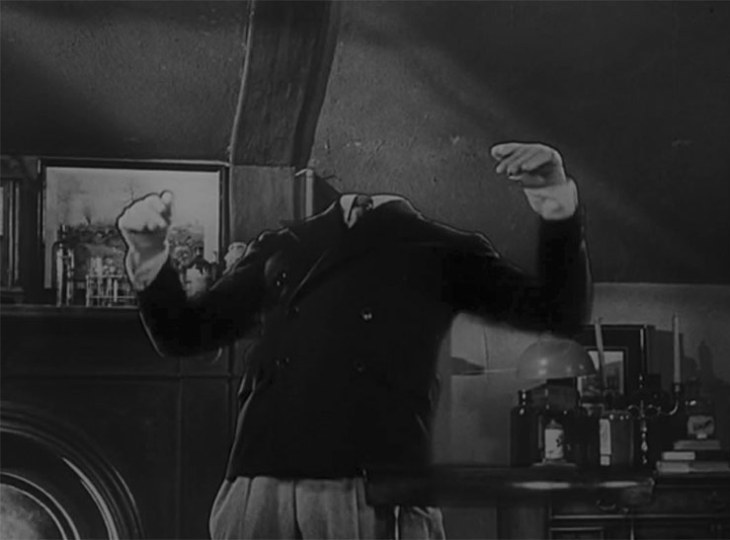
The special effects of The Invisible Man are still impressive, 90+ years later. John P. Fulton was put in charge of making the Invisible Man, well, invisible. He would later explain the process, which included dressing Rains in black felt for the areas that needed to be invisible and filming him in a room covered in the same fabric. A negative matte of these shots was then composited with the positive areas of the actual scene, using the negative to mask out the areas where the invisible man would appear. The detail required was incredible and included necessities like matching the lighting between scenes, positioning of objects for Rains to interact with, and in one scene the removal of bandages in a mirror, affectively showing two invisible men at the same time!
Even small details, like the moving of books, the opening of doors and windows or the knocking off of a hat were given the same level of attention, and it gives the effects a quality that is missing from some later productions. Things appear to move with intent and weight, exactly as they would if someone was interacting with them.
Other notable effects include some miniature work (with a train derailment and a car going off a cliff) as well as the tense final confrontation, where Griffin’s footprints appear in newly fallen snow. This latter effect was achieved with footprint-shaped cutouts in a board that were pulled away, causing the “snow” to fall into the resulting depression.
I would have loved to see this film when it was originally released, if only to watch the expressions on the faces in the audience. Nothing like this had ever been seen before, and audiences were thrilled, horrified and fascinated.
Fulton would go on to do effects on movies like The Bride of Frankenstein and Rear Window, winning three academy awards for Photographic Effects – including one for the The Ten Commandments.
He’s Invisible, That’s What’s the Matter with Him.

The appeal of being invisible is universal. To see and hear things that would normally be impossible. To simply slip away, unseen, or arrive the same way. Never mind that – in the movies anyway – it always drives you mad or is sought after by the mad already.
This is why I don’t trust those scientists working on an invisibility cloak. You just know one of them is going to go on some kind of rampage, eventually.
Griffin is mad, of course, but the inclusion of monocane in his experimental concoction is blamed for his mental condition. This neatly obviates the need for us to wonder just what kind of person would attempt the experiment in the first place. He wasn’t mad to try, it was the experiment itself that made him that way! I’m not buying it, however. I can’t think of a selfless reason for making yourself invisible. It’s always about satisfying some darker element of the human psyche. About prurient interest or a physical advantage. Maybe it’s a shortcoming of my own brain that I can’t conceive of a mutually beneficial reason for invisibility. (Except, maybe, for tall people sitting in front of me at the movie theater.)
The movie doesn’t really deal with any of those issues. Griffin starts as a lower-case ‘m’ madman and progresses into a capital ‘M’ Mad Scientist. Rather than a morality tale, however, the film is a darkly comedic thriller, with just a touch of humanizing romance. Not enough to really make Griffin likable, but he’s an entertaining lunatic. (I still laugh out loud at a pair of disembodied pants skipping down the road, singing “Nuts in May.”)
If we look at the history of “invisible person” films we see that those that aren’t comedies tend to involve men behaving badly. From the original film, through knockoffs like Hollow Man all the way to 2020’s Invisible Man remake. Invisible women seem to fare better with the ability (power, curse, whatever), at least that’s what Sue Richards of the Fantastic Four suggests. I don’t really know what to make of that, but at least in the comedies, things aren’t quite that straightforward.
It is disturbing what Griffin thinks will cause the world to capitulate to his will. A few murders, a few disasters. Merely the threat of his existence and what he can do should cow the world. I always thought that was laughable, but nowadays I’m not so sure.
An Invisible Man Can Rule the World – The Legacy of the Invisible Man

It’s probably going too far to say that The Invisible Man saved Universal Studios in 1933, but its success certainly went a long way toward keeping the lights on. It was wildly successful, and The New York Times listed it as number one in its list of 10 best movies of the year. Even France, which, at the time, limited the number of theaters American movies could play in, gave The Invisible Man special dispensation because of its “extraordinary artistic merit.”
The success of the film led to five Universal sequels, including Abbot and Costello Meet the Invisible Man. While the original film didn’t get a remake until Leigh Wannell’s 2020 version, the concept of an invisible person has found fertile ground in film, television, books, and comics. From Marvel Comics’ Invisible Woman to Nobuo Adachi’s The Invisible Man Appears to Chevy Chase in Memoirs of an Invisible Man.
As recently as last year Elizabeth Moss has said that a sequel to The Invisible Man was in development, so Griffin and his heirs are still with us. Not that we’d know, even if they were in the same room.
What are your thoughts on The Invisible Man? Share them down in the comments!
