
The New York Times just recently published its list of the best films of the 21st century and while the list itself is solid, it left out dozens of unforgettable films that have defined cinema in the past two decades—bold experiments, overlooked gems, cult classics, and masterpieces that slipped through the cracks of critical consensus. Since it was a collaboration of 500 artists working within Hollywood, only the most prestige titles made the cut, which normally would be fine if it wasn’t for the fact that they had a quarter of a century to pull from. It’s impossible to whittle 25 years down to 100 titles; there were bound to be omissions. Some were baffling, others understandable, but all left us wondering: What about the rest?
This list isn’t a rebuttal—it’s a celebration of what got missed. These are the movies that pushed boundaries, built worlds, broke hearts, or simply did something unforgettable. Some were box office flops, others award-season darlings. Some changed genres, while others created their own. All of them, in their own way, helped shape the cinematic language of the 21st century.
These are the 100 Best Movies of the 21st Century (That Didn’t Make The New York Times’ List).

40. RRR (2022)
There’s over-the-top… then there’s “dude just picked up a motorcycle and used it like a Louisville Slugger” over-the-top. Welcome to RRR, a movie that treats your suspension of disbelief like a joke and makes fun of you for even trying to apply logic to it. Set in 1920s colonial India, RRR (short for Rise Roar Revolt, which might as well stand for Ripped Raging Radness) tells the bromantic fever dream of two freedom fighters—Rama Raju (Ram Charan) and Bheem (N.T. Rama Rao Jr.)—who become besties before discovering they’re on opposing sides of a revolution. It’s basically Fast & Furious if Dom and Hobbs were Indian demi-gods with the emotional range of Shakespearean titans and the gym routines of anime characters.
The film opens with a child kidnapping, jumps to a man suplexing a crowd by himself, and then smashes the throttle for three hours without ever letting off the gas. There’s a tiger fight, a flaming horse-drawn carriage, a prison break via backflipping shoulder combat, and the single greatest “man runs through fire wielding two torches while screaming vengeance” shot in cinematic history. The action? It’s Looney Tunes reimagined by Stephen Cow high on ayahuasca. Wire-fu? Check. Fistfights where gravity is merely a suggestion? Check. A battle where a man throws wild animals at British soldiers like Pokémon?
Buddy, this movie doesn’t just check boxes—it invents new ones to check. But beneath the mayhem, there’s a pulsing, patriotic heart. Rajamouli weaponizes myth, legend, and friendship like ballistic missiles, crafting a story so earnest it could only work because it believes in its own madness. RRR isn’t subtle. It’s a firecracker in a fireworks factory. It explodes with purpose. If you’re going to watch one Bollywood epic, make sure it’s this one. You will not be disappointed and despite its gargantuan runtime would have you believe, you surprisingly won’t be bored.

39. Road to Perdition (2002)
Road to Perdition is underrated in just about every category it belongs to. No one ever mentions it when discussing the greatest gangster movies, it never comes up when talking about the best films of Hanks’ filmography and it’s always left out of the conversation of the best comic book adaptations. Which is insane considering every element of the film is perfect. The performances are stellar across the board but Hanks is a revelation. He is mesmerizing in a rare morally gray role. His stoicism isn’t a wall—it’s a crumbling dam holding back years of blood, regret, and fatherhood he can’t quite express.
The cinematography is on another level; this is Conrad L. Hall’s symphony. Every frame is painted with blues and grays, lit like a Caravaggio, and composed like a Rembrandt. And Sam Mendes’ direction feels like it harkens back to the old school Cagney pictures while also being distinctly his own style. The plot is simple but its themes are complex. Fatherhood. Legacy. Violence as inheritance. The cyclical nature of sin. Mendes doesn’t give us clean answers or absolution. Sullivan’s journey with his son is a pilgrimage toward the illusion of peace, the idea that perhaps if you shield your child from who you are, he won’t become you. But the movie knows better. Road to Perdition is more than a gangster film. You can strip away all of the noir trappings and genre iconography and it would still work because at its center, the film is simply about a boy trying to understand the man he called “Dad.”

38. The Shape of Water (2017)
When Guillermo del Toro first saw the Creature From the Black Lagoon as a child, he was left crestfallen. Not because the creature died at the end but because he didn’t end up Julie Adams. He carried that emotional devastation with him for decades until he was able to rewrite cinematic history and give the Creature the happy ending it always deserved. He gave it a love story. Even though it’s been criticized for being derivative and outright sued because it allegedly stole the premise from an old obscure play or some shit, The Shape of Water is 100% del Toro. It’s critics and attackers have no leg to stand on because while it’s kinda sorta similar to other stories, it’s wholly original in its approach. It’s a weird as hell modern day fairy tale about a lonely mute (Sally Hawkins) falling for a fishman, a bad guy (Michael Shannon) trying to stop her and friends who don’t kink shame her. It’s essentially Beauty and the Beast but with fucking.

37. Wet Hot American Summer (2001)
Wet Hot American Summer is a parody of ‘80s summer camp comedies that acts like an unhinged Molotov cocktail of sketch comedy, meta satire, and madcap lunacy. It’s like if Meatballs got drunk on Mad Dog 20/20, wandered into a David Wain fever dream, and decided to embrace the wackiness. The cast? Pre-fame demigods who now rule Hollywood like a cabal of improv-trained warlocks. Paul Rudd (who has never aged), Amy Poehler, Bradley Cooper, Elizabeth Banks, Michael Showalter, Janeane Garofalo, and Christopher Meloni—all dialed up to 11 on the chaos meter. Every scene feels like it was written by aliens trying to reconstruct human behavior after watching 30 seconds of Saved by the Bell and 40 hours of Tim and Eric.
The film’s setting (the last day of camp at Camp Firewood, 1981) is the thinnest of clotheslines in which to hang non-stop MAD Magazine level jokes. Not since Airplane! has a movie assaulted the viewer with as many; they’re tossed around like dodgeballs—some hit, some miss, but all are thrown with the manic energy of a raccoon hopped up on Pop Rocks. If you’ve ever wished your favorite SNL skit would just keep getting weirder until it collapsed into a black hole of meta absurdity and dirty jokes, Wet Hot American Summer is your spirit animal. It occupies the same rarified cult comedy space as Hot Rod, The Foot Fist Way, Napoleon Dynamite and MacGruber—if you love them, there’s nothing funnier but if you don’t vibe with it, it’s a more excruciating experience than being forced to wrestle bees.

36. Training Day (2001)
“To protect and serve” got curb-stomped, left in a ditch, and replaced with “smoke this PCP and shut the fuck up.” Welcome to Training Day, where the badge don’t mean justice—it means you belong to me now. Denzel Washington didn’t just win an Oscar for this. He collected it like a debt. Like a shark in a three-piece suit with a shotgun grin and a morality held together by duct tape and cocaine, he became Alonzo Harris. It’s one of the most shocking examples of an actor playing against type. Not since Henry Fonda in Once Upon a Time in the West has an actor primarily known for heroic or kind characters played someone so despicable. Set over the course of one bad, Training Day drops rookie Jake Hoyt (Ethan Hawke) into the lion’s den. The lion? Denzel.
And he ain’t just hungry—he’s starving for power, respect, and just a little more time to pay off some very angry Russians. The movie is a tight 24-hour descent into moral hell. It starts with a cup of coffee and ends with blood in the streets and a monologue so nuclear it should be wrapped in caution tape. By the time Alonzo screams “King Kong ain’t got shit on me!,” he’s already burned the kingdom to the ground and pissed on the ashes. Antoine Fuqua directs like he’s been shot at. The pacing is tight, the streets are alive, and every scene is soaked in grime, tension, and that post-‘90s swagger that comes really close to capturing the attitude of the ’70s. Which is the highest compliment a movie can get. Training Day is the gritty, morally bankrupt, sweat-soaked baptism of fire that showed the world Denzel could play bad and make it look damn good.

35. The Lighthouse (2019)
Two lighthouse keepers (Willem Dafoe, Robert Pattinson) try to maintain their sanity while tending to a lighthouse on a remote island in the 1890s. Much like how Tarantino’s films are a cinematic patchwork of the director’s influences, The Lighthouse is everything Eggers has ever loved or was inspired by, thrown into one giant pot. The film feels like Kubrick doing Bergman doing H.P Lovecraft. Shots linger on images far too long, the pace is glacier, nothing is ever explained and the sound design and aspect ratio are designed to make you claustrophobic and annoyed, which is a good thing. This film’s idea of answering a riddle, is to provide the audience with an even crazier riddle. Since the meaning behind the events of the film are up for interpretation, I don’t believe it’s a spoiler to say that the film juggles at least five or so explanations. The main characters could both be dead and are now in purgatory or hell, they could be the same person, there could be a force within the lighthouse that’s driving them mad or it could just be a tale of insanity. There’s many ways to interpret this film and the fact that it supports them all, is just brilliant. This is a new master working at the top of his game.

34. The Raid: Redemption (2011)
The Raid: Redemption is an action film fan’s dream. It only just sets up its main characters when it thrusts them into a terrifying scenario, following a group of police officers tasked with taking down a crime lord in a 30-storey building he controls with an iron fist. It uses its environment to perfection, where tight spaces become vibrant playgrounds for brutal violence. The everyday terrain of stairs, small rooms, and windows overlooking sheer drops are all used to its full extent. Oftentimes being filmed using handheld cameras, The Raid’s action is incredibly immersive, with extended fight scenes that blend the gritty realism of shootouts with the back-and-forth brutality of hand-to-hand combat. The specific fight style incorporated in the film, Silat Harimau, embodies this cocktail of violence, grounding this blood-drenched action film in The Raid‘s native country of Indonesia.
–Cian McGrath

33. The Incredibles (2004)
The Incredibles might just be the best superhero film ever made. Just like Alan Moore before him, Brad Bird knew that the superhero genre works best when there were actual real life stakes and character drama propelling the story, not cataclysmic events. Audiences will buy into the fantastical or even the preposterous as long as they like the characters and are invested in their struggle. A family of super powered near demi gods is not relatable in the slightest but everyone understands the pain of feeling obsolete, the fear of losing your partner or what it feels like to watch the world change suddenly before you to such a degree, that you start to question your value or usefulness. The Incredibles deals with all those themes and so much more. Bird showed up with a cocktail of Cold War paranoia, mid-century futurism, and superhero burnout, and poured it into an atomic blender. The result? A film that’s equal parts Fantastic Four, Watchmen, and Mad Men, served with a martini glass full of marital tension and daddy issues.
Bob Parr, aka Mr. Incredible (Craig T. Nelson), is every man who used to lift cars and now lifts complaints from middle management. He’s built like a fridge but trapped in a cubicle. He’s bored, broken, and nostalgic for the days when punching robots in the face meant something. And then there’s Helen Parr, aka Elastigirl (Holly Hunter), who juggles parenting, trauma, and rubber-band warfare like a queen. She’s the real MVP—flexible in both body and brain, holding the whole damn movie (and family) together while her husband plays vigilante. Their kids? Violet is a teenage anxiety spiral wrapped in invisibility, and Dash is a pint-sized cocaine rush with shoes. Jack-Jack is a diaper-clad WMD. Together? Dysfunctional. Dangerous. Delightful.
Enter Syndrome—part fanboy, part fascist, all villain. Jason Lee voices him like a Reddit thread that learned how to kill. He’s toxic fandom personified. He doesn’t want to destroy the world, he wants to be the one who saves it so he can sell action figures and sign nerd girl tits at Comic-Con. He’s one of the most unique super villains to ever grace the screen. The Incredibles is first and foremost a superhero film but it’s more than that. It’s a movie about purpose. About relevance. About the slow, soul-killing grind of settling for less when you know you were built for more. It’s about family. Sacrifice. Redemption. And punching your way out of middle-age malaise with a fist full of love.

32. Hot Fuzz (2007)
As much as I love his films after they stopped collaborating, it really feels as though Edgar Wright needs Simon Pegg to make a no notes, undeniable masterpiece. They’re alchemists who turn any genre idea into gold. Not only dead they singlehandedly bring back the zombie movie but they somehow managed to turn a Agatha Christie / The Wicker Man type mystery into a legit action comedy. Hot Fuzz is the middle child of the Cornetto Trilogy but don’t let that fool you—this one’s the overachiever. It’s Point Break with tea, It’s Bad Boys II in tweed. Simon Pegg stars as Nicholas Angel—so good at being a cop, he’s punished for it. He’s the type of man who gives a speeding ticket at a school zone then arrests the ice cream man for loitering.
Transferred from London to the sleepy village of Sandford (murder capital of rural England), Angel is partnered with the doughy man-child Danny Butterman (Nick Frost), whose encyclopedic knowledge of action movie tropes is second only to your high school stoner friend who swears Hard Target is Van Damme’s best. The film starts like a BBC procedural. There’s gossip, gardens, and a goose on the loose. But then the bodies start piling up like crates in a Michael Bay warehouse explosion and things go absolutely tits up. The last thirty minutes are a blood-soaked ballet of pensioners with shotguns, exploding heads, and bicycle chases so intense they should be scored by Hans Zimmer on fire. Hot Fuzz isn’t just a great comedy, It’s a cinematic shotgun blast through the heart of action cinema, fired by two best friends who love movies so much they made one that contains all of them. It’s hilarious. It’s heartfelt. It’s high-caliber cinema and it might be Wright’s best movie.

31. Son of Saul (2015)
Before Orson Welles directed Citizen Kane, he originally wanted to do an adaptation of Hearts of Darkness filmed entirely through the point of view of the main character, like the film Hardcore Henry or the Smack My Bitch Up video. The producers thought it was too ambitious and shot it down immediately (I believe their actual words were “bitch, you crazy”), so he scrapped it and decided to troll Hearst instead. Cut to 2015 and Director László Nemes has a similar idea except he doesn’t want to do Hearts of Darkness, he wants to do Schindler’s List and he doesn’t want to shoot in POV but in extreme close-ups. The result is the astonishingly powerful Son of Saul.
Saul (Géza Röhrig) is part of the ‘Sonderkommando’, a group of prisoners in Auschwitz who are tasked with cleaning up the gas chambers, removing the bodies of executed Jews and burning their bodies in the crematorium before the next are sent to their deaths. One of the corpses he has to bury is that of a child boy, a child boy who looks a helluva lot like his son. The rest of the film we follow Saul in his attempts to find a rabbi to give his “son” a proper burial. Whether or not the boy is or is not his actual son, is irrelevant. As is whether or not Saul thinks it is or knows it isn’t. It’s about a desperate man in a desperate situation who desperately wants something to believe in. It’s not about the boy.
The burial of the boy is a burial of sin. A burial of regret and guilt. Beyond whether it’s the right thing to do, it’s the only thing he can do. He’s run out of reasons to keep going and this will give his life purpose. Uniquely shot in that the camera is tight on the actor at all times, never leaving his point of view. Everything in his periphery is blurry and out of focus, which forces you to never take your eyes off of him. It forces us as an audience to bear witness, which is the most important thing a film about the holocaust could do.

30. The Wrestler (2008)
Darren Aronofsky is a poet of pain and high priest of human breakdowns. His films feel like churches whose sermons consist of nothing but human suffering and sorrow. He worships at the altar of heartbreak, with The Wrestler being one of his most emotionally draining and soul crushing. Nothing tops the misery porn of Requiem of a Dream but this comes close. “I’m an old broken down piece of meat… and I deserve to be all alone.” If that line doesn’t hit you like a steel chair wrapped in regret, The Wrestler ain’t for you. But if it does? Brother, welcome to the ropes. The Wrestler isn’t just a film. It’s a eulogy for the spotlight. It’s the last cigarette after the encore. It’s Rocky stripped of sentimentality and nostalgia.
Mickey Rourke doesn’t play Randy “The Ram” Robinson—he IS Randy. This is a man held together by tape, tanning oil, and the kind of desperation you can’t fake. His body’s a roadmap of bad choices. His heart’s a time bomb. And his soul? Still swinging for the cheap seats, long after the crowd’s gone home. As much as I love Nic Cage and think he would’ve been great in the role (he was originally attached but had to pull out), he lacks the lived in weariness and desperation for one more great match that Rourke has. He gets Randy on a more personal level.
Randy’s a relic from an era where wrestling was blood and sweat, not corporate logos and pyrotechnics. He’s doing death matches in VFW halls, stapling dollar bills to his face, living out of a van, chasing the ghost of who he used to be. This isn’t Hulkamania. This is Sadamania. This is what happens when the crowd stops chanting your name. The Wrestler isn’t about wrestling. It’s about identity. Addiction. The cost of applause. It’s a heartbreak in slow motion, set to an ‘80s metal soundtrack and stitched together with scars. Mickey Rourke gave us his soul, and Aronofsky turned it into a monument to every washed-up dreamer who couldn’t let go.

29. Dear Zachary: A Letter to a Son About His Father (2008)
Like Lenny and the rabbits, some movies can’t be gentle no matter how hard they try. Dear Zachary: A Letter to a Son About His Father is a gut punch that rips out your heart and throws it into the ocean. You think you’re ready. You’ve seen sad movies. You’ve cried at Pixar. You’ve survived Grave of the Fireflies and didn’t flinch at Requiem for a Dream. But nothing (and I mean nothing) prepares you for Dear Zachary. What starts as a love letter turns into a horror story. A eulogy becomes a crime scene. A tribute unravels into tragedy so devastating, you’ll question the laws of reality, morality, and how the hell this country still functions with a justice system made of cowards, impenetrable red tape and bad decisions. Kurt Kuenne made this film for his murdered best friend Andrew Bagby.
Not for profit. Not for prestige. He made it so Andrew’s unborn son, Zachary, would one day know his father. Who he was. What he meant. How deeply he was loved. It’s stitched together with home movies, interviews, and memories. It feels like a scrapbook come to life—until it doesn’t. This isn’t your average “true crime” binge. There are no detached talking heads. No Netflix polish. No smug re-creations. This is raw. This is bleeding. It is a cinematic scream, not just at the murderer but at the bureaucratic black hole that enabled the unthinkable. The kind of jaw-dropping failure that should be impossible in a world with working phones and a thing called “common sense.”
Dear Zachary will destroy you. You will cry. You will go blind with anger. You will Google Canadian extradition law and start pacing. But you must watch it. Because some stories matter too much to turn away from. This is more than just a documentary, it’s a call to arms, a beautiful Viking cry from one friend to the other and a beautiful tribute to Kate and David Bagby—Andrew’s parents. Two humans forged in grief, standing in the fire without burning. Their strength is mythic. Their pain? Biblical. They don’t just hold the film together, they break you with their grace, then rebuild you with their defiance. In a decade ruled by gods in capes, they’re easily the biggest heroes of the era.

28. Shoplifters (2018)
A morally complex film that ponders what means to be a family and how right and wrong can coexist in the same action, Shoplifters is a warm hug of a story that straight up sucker punches you in the heart. A family of thieves use their shoplifting skills to take care of a child they find abandoned outside in the cold. They kidnap her in order to give her a better life but as well intentioned as they are, they did steal her and they also immediately start teaching her to steal, so they’re on shaky moral ground, which plays into the themes of the film. When is thievery justified and does blood alone make you family?
The family at the center of Shoplifters has a stronger bond than almost any I’ve ever seen in film and yet they’re not technically a family by the strict definition of the word and the little girl’s “real” family are garbage human beings but they did birth her, so does that make them more of a “family” or less? The questions the film raises aren’t exactly new but the film succeeds because it is so clearly passionate about what matters most: the characters. The characters are so well written and likable, you don’t care if they’re right or wrong, you just want to see them together. Which creates a sense of overwhelming dread that something terrible will happen to tear them apart. By the end, you realize the film was an emotional assassin whose only target was your heart.

27. American Psycho (2000)
It’s 1987 and Patrick Bateman works for an extremely successful investment banking firm. He wears the slickest suits and is in peak physical shape. He’s a yuppie that bitches about other yuppies and has a strong affinity for Huey Lewis and the News. He flaunts his business cards as a sign of vanity and ego and enjoys the company of prostitutes. He also murders people. There’s been much debate on whether or not the events of the film actually take place or if they are just the delusions of insanity but the writer and the director both maintain that the majority of the evil Bateman commits throughout the film actually happened.
I’m assuming that includes the scene with the ATM demanding payment in the form of a kitty’s sacrifice. Or maybe ATMs in the 80’s were actually evil. It was a different time. Mary Harron’s adaptation walks a tonal tightrope, balancing grotesque violence with biting black comedy. It skewers materialism, toxic masculinity, and the soulless pursuit of status with a scalpel’s precision. The infamous business card scene, the Huey Lewis monologue, and Bateman’s eerie detachment all contribute to a chilling portrait of alienation in a world where identity is performance. Equal parts disturbing and hilarious, American Psycho is less about the murders and more about the emptiness of a man (and a culture) defined by surfaces. Whether Bateman’s crimes are real or imagined is ultimately irrelevant; the horror lies in how little anyone cares either way.
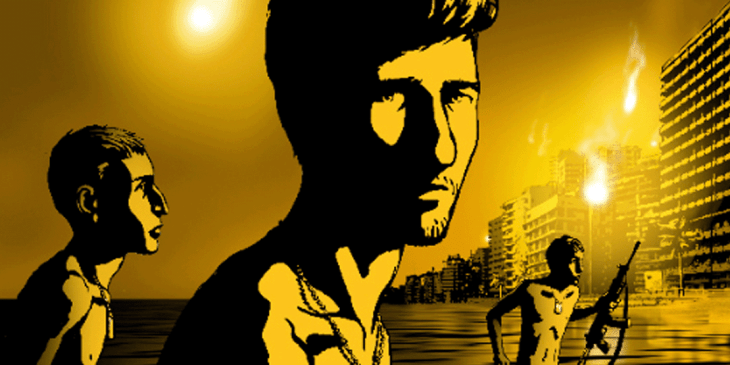
26. Waltz with Bashir (2008)
Memory is a liar and trauma is its editor. And Waltz with Bashir is the illustrated footnote scrawled in the margins of a chapter we pretend doesn’t exist. Ari Folman is a former Israeli soldier trying to remember what he’s spent half his life forgetting: his role in the 1982 Lebanon War and the Sabra and Shatila massacre. But his memory’s on mute, and instead of answers, he gets surreal flashes of floating bodies, howling dogs, and soldiers waltzing through gunfire like they’re in a fever dream choreographed by PTSD. This is not your typical war film. There are no heroes. No triumphant moments. Just half remembered nightmares that leave scars. It’s also not your typical war film in the sense that it’s an animated documentary.
And so begins a journey through animated atrocity, a docu-hallucination, where conversations with old comrades slowly rebuild a mosaic of trauma that was never truly gone, just buried under layers of denial, guilt, and psychological survival mechanisms. The animation is a masterstroke: rotoscoped nightmares drenched in sickly yellows, cold blues, and apocalyptic oranges. It’s not realism—it’s the visual equivalent of haunted regret. Think Persepolis by way of Apocalypse Now, but every frame is a confession that’s been forcibly repressed. Waltz with Bashir is an anti-war film that uses memory as its battlefield and leaves you shell-shocked in your seat.

25. Four Lions (2010)
For satire to work, it has to hit every target it’s aiming at while simultaneously being funny and smart. It’s a delicate balancing act that’s incredibly difficult to pull off. Tip too far in one direction and you have a preachy melodrama. The other, a flat comedy with no bite. And that’s just for “normal” satires. You know, the ones about Hitler and such. Four Lions deals with such controversial subject matter, I’m amazed it was made. Making a comedy about terrorists in Britain, is almost as ballsy as making a comedy about school shootings in America, especially considering its an ongoing problem. But Christopher Morris manages to pull off the impossible. He made a film about suicide bombers funny. It’s a brilliant takedown on religious extremism, radical fanaticism and idiotic ideologies. The film will either make you laugh or piss you off but it’ll definitely make you think.

24. The White Ribbon (2009)
There’s cold cinema and then there’s Michael Haneke. He doesn’t just serve his stories cold, he cryogenically freezes them in sheets of unrelenting dread and sprinkles in existential nihilism for flavor. He makes misery porn for arthouse sadists and The White Ribbon is one of his most unrelenting experiences. Imagine if The Village of the Damned and Come and See had a baby who refused to smile and that’s this film. Set in a pristine, Protestant German village just before WWI, the film unfolds like a morally diseased fairy tale: the doctor’s horse is tripped by wire. A woman falls to her death in the mill. A barn is burned. A child is whipped. No one talks. Everyone watches and not a single person is happy.
This is Hans Christian Anderson and the Brothers Grimm but without any fantasy elements and nothing but the pitch-black parable at its center. Shot in eerily beautiful black-and-white, Haneke turns every frame into a gothic postcard from Hell, where shadows do more damage than any visible knife. It’s gorgeous, but suffocating. Elegant, but cruel. And like the white ribbons the children wear to symbolize purity, the whole thing feels like a tight noose disguised as virtue. The White Ribbon isn’t scary in a traditional sense—it’s terrifying in the way a whisper can be more menacing than a scream. There’s no catharsis. No justice. No answers. Just a quiet accusation echoing across time: This is how evil starts. This is how we make it. And this is why we look away even though we need to confront it head on.

23. The Assassination of Jesse James by the Coward Robert Ford (2007)
Every generation has a Western so profound, it’s immediately referred to as “the death of the Western.” Some said The Cowboys was the end due to the Duke dying in it, while others call Eastwood’s Unforgiven the last great swan song. While both are great, I think the title belongs to The Assassination of Jesse James by the Coward Robert Ford. This is a slow-motion eulogy whispered over the corpse of American legend. A meditation on celebrity, obsession, and the quiet, echoing emptiness that follows a gunshot. Andrew Dominik isn’t interested in shootouts or saloons. He’s carving a tombstone in real time, and it’s shaped like Brad Pitt’s ghost. As Jesse James, Pitt plays the outlaw like a man already dead—haunted, hollow-eyed, and perpetually ten steps ahead of everyone else, including the camera. He’s not a person. He’s a myth in the shape of a man, dragging his own legend behind him like a coffin with spurs. While the actor is a decade older than the man he’s portraying, it ultimately doesn’t matter.
As historically accurate as the film is, it’s still dealing in myth and legend, and that’s exactly what Pitt is playing. A man worn down by the legend associated with him and tired from being one step ahead of the grim reaper. It’s easily one of his best performances but it unfortunately takes a backseat to Casey Affleck as Robert Ford. He idolizes Jesse the way lonely kids idolize superheroes: posters on the wall, stories memorized, delusions of grandeur fermenting into toxic need. Ford doesn’t want to be Jesse James, he wants to replace him. And like any good American tragedy, the only way to become someone… is to kill them. Roger Deakins shoots the film like he’s trying to blind God with beauty—hazy skylines, frost-covered fields, and silhouettes carved from melancholy. Every frame looks like it was dipped in whiskey and forgotten in a photo album. You could hang this film in a museum and charge admission. But beneath the painterly visuals and Nick Cave’s sorrow-drenched score is a knife twisting in the gut: the death of myth. This is a story about how we build legends, how we tear them down, and how nobody ever survives either side of it.

22. Hereditary (2018)
Some horror films live and die by their premises. They ask an audience to believe a guy can kill you in your sleep or that a little boy can see ghosts. Some horror films live and die by their villains, others by how much sex and violence they promise, and a select few live and die by the performances. While Aster crafted a horror film so head and shoulders above the majority of its respected genre, critics referred to it as “elevated horror,” the film, as good as it is, is only as strong as its performances.
Hereditary would not have worked if the lead was weak. The character of Annie needed an actress who could run the full gamut of emotions, who could inspire sympathy and disgust in the audience. You needed to believe her but there also needs to be doubt. Is she crazy or is something malicious happening to her family? Hereditary is a perfect example of a film being completely dependent on the strength of the central character and Toni Collette knocks it out of the park. She turns what could’ve easily been a standard-issue possession story into a meditation on grief, loss, and mental health. Her performance adds layers of complexity to the film. It’s one of the best performances in any horror film to date. It just happens to also be one of the best horror films ever made.

21. Dune: Part Two (2024)
Dune: Part Two is nothing short of breathtaking. It is a cinematic odyssey that delves deeper into the intricate tapestry of Frank Herbert’s universe, delivering a visual and auditory spectacle that is both mesmerizing and, at times, emotionally resonant. It has all the cinematic grandeur of the first but with a far more compelling story. Picking up where the first installment left off, we follow Paul Atreides (Timothée Chalamet) as he navigates the treacherous sands of Arrakis, seeking refuge among the Fremen and embracing his destiny as a messianic figure. Chalamet’s portrayal captures the internal conflict of a young man burdened by prophecy, delivering a performance that is both compelling and nuanced.
Zendaya’s Chani steps into a more prominent role, serving as both guide and confidante to Paul. Their chemistry is palpable, adding a layer of human connection amidst the film’s grandiose narrative. The supporting cast, including Rebecca Ferguson as Lady Jessica and Javier Bardem as Stilgar, provide depth to the story, grounding the epic in personal stakes. However, it’s Austin Butler who ultimately steals the show. Elvis proved he is more than a Disney kid, but this proves he can do anything. Every time he is on screen, the film cackles with electricity. It’s a far cry from Sting and his weird speedo. In an era dominated by franchises and sequels, Dune: Part Two distinguishes itself as a work of art that challenges and rewards its audience. It is a film that demands to be seen on the largest screen possible, a reminder of the immersive potential of the cinematic experience. Villeneuve is at the top of his game and no one is even close.
60-41 | 20-1
Were you surprised by which movies made (or didn’t make) The New York Times’ list? Do you agree with my selection of picks so far? Let us know in the comments below!
The official ScreenAge Newsletter has arrived! Subscribe to receive a semi-regular round-up of all our exclusive content, including reviews, editorials, Top 100 lists, and more! C'mon, we know you want to venture further into the Wasteland with us!
